




Pink tricorn hats festooned with shiny stars and fluffy pompoms were unheard of in the 18th century, but on March 28, at the Durant-Kenrick House and Grounds, they were the height of fashion for children attending the Revolutionary Newton program.

“That’s amazing,” said 5-year-old Margot, whose parents withheld her last name, about the arts and crafts activities on offer at the Historic Newton property. After making her own custom hat – complete with a red feather – she and her parents explored the museum.
The family was among more than 300 visitors who came to the house to learn more about life 250 years ago, said Lisa Dady, Executive Director of Historic Newton. The program was held in honor of the country’s semiquincentennial.
Reenactors dressed in period-accurate, handmade clothing and demonstrated centuries-old activities outside and inside the Georgian farmhouse that was built circa 1734, according to Historic Newton.
“If you live it [history], you can appreciate more what they went through and experienced on a daily basis,” said Johnathan Seredynski, who portrayed a soldier from Greaton’s 3rd Massachusetts Regiment from the year 1777.
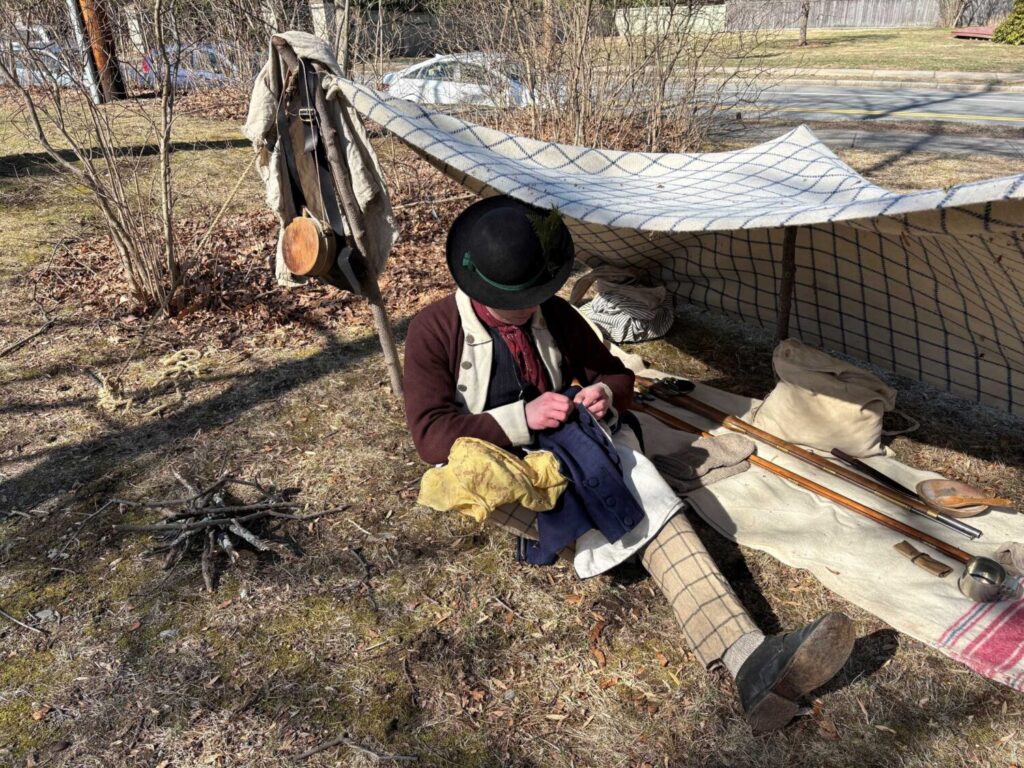
Standing next to a blanket shelter he built on the Durant-Kenrick grounds, the Albany, NY, resident proceeded to sew a button onto his jacket, a familiar task for 18th-century soldiers. The simple lean-to would keep the dew off a person’s clothes but was useless in the rain. It was meant to be built and disassembled quickly since armies were always on the move, he said.

Seredynski, who wore a sprig of greenery in his hat for luck, began participating in reenactments in 2009 because of a “general love of history.”
In addition to his period-accurate clothing, Seredynski also filled his blanket shelter with items a typical 18th-century soldier might have had with him while on the march, including a knife, a wooden “cheesebox” canteen, and two guns: A “fowling piece” for hunting and a “first-model Brown Bess.”
“The ‘Brown Bess’ muzzle-loading smoothbore musket was the most common weapon used by both the British and Americans forces during the [Revolutionary] War,” according to the U.S. Department of War.
Like other reenactors, Seredynski also knew how to properly clean, maintain, and fire the guns, with an emphasis on safety.
Beyond enjoying history, he said he liked “the camaraderie with my fellow reenactors” as well as camping. “Everyone’s very dedicated.”
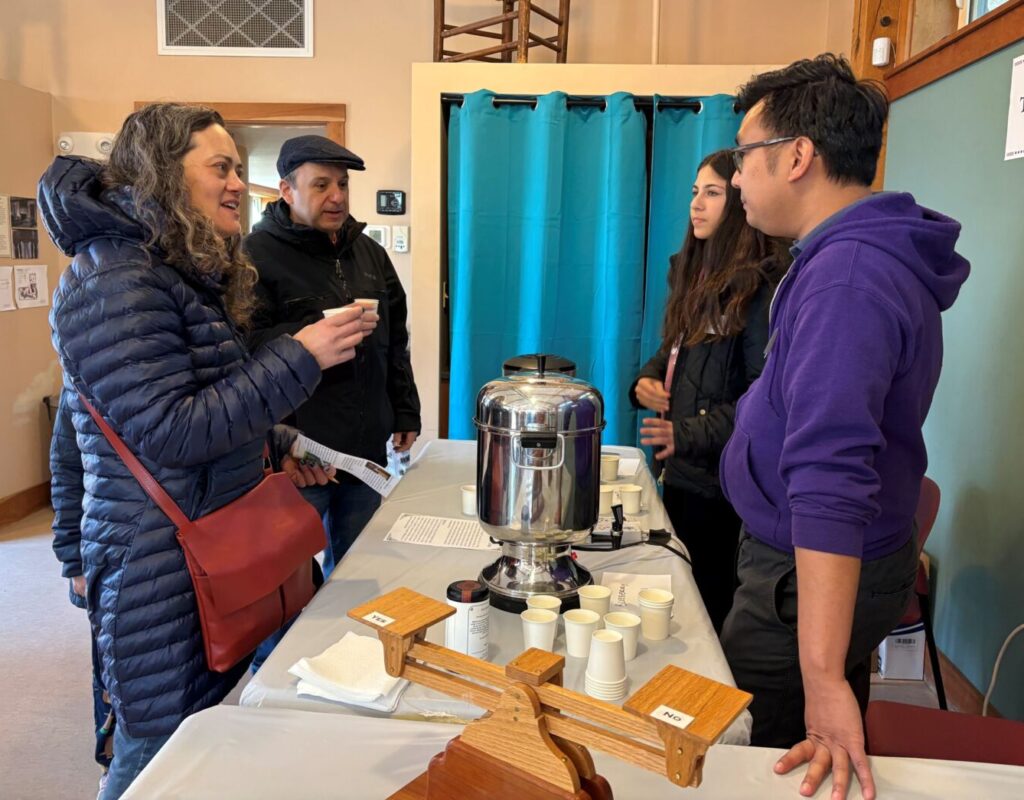
Inside the home, the Historic Newton program invited visitors to make decisions about an important 18th-century activity – tea drinking.
After reading information about the Boston Tea Party, which took place on December 16, 1773, tasters decided whether they preferred sipping cups of “Loyalist” bohea tea or “Patriot” blueberry tea.
“In rebellion against British taxation, colonists began drinking Dutch bohea tea and domestic American tea rather than [British bohea],” according to Historic Newton. By the 1770s, “Many turned to domestically produced teas made from crops native to the Americas,” like blueberry. At that time, British tea was said to be poisonous and “represented oppression and control,” according to Historic Newton.
Volunteers Fia Parnes and Tony Tran, who ran the tea station, both preferred the blueberry beverage – although others enjoyed the British version of the drink.

In the Durant-Kenrick kitchen, reenactor Larissa Sasgen wore meticulously sewn, beautifully designed garments she made, including a white cap. She and her husband John Nichols came from Quincy to answer visitors’ questions about 18th-century life. Sasgen provided more information about tea and other popular beverages of the time – and today – including coffee and hot chocolate.

The two have been involved in living-history programs all their lives. In fact, Sasgen said her family began participating during the country’s bicentennial in 1976 and has been stepping back in time ever since.
Asked what she enjoys most about reenactments, Sasgen said, “I like being able to represent people who would not necessarily have a voice [in the 18th century],” like women, minorities, and those who could not read or write.
...Other News...
 From retirees to students, Newton protesters rally at ‘No Kings’ demonstration


