




Children, young adults, and older adults arrive at the Carroll Center for the Blind reluctant to leave behind their homes and families. By the time they graduate, however, many struggle to leave the community they have found at the Center, but they are newly empowered to do so.
President and CEO Greg Donnelly walks the winding paths, passing neatly maintained lawns and gardens beginning to bloom for spring.
Every element of the campus is built with blind and visually impaired travelers in mind, though not in a way that removes challenge entirely. The walkways vary in texture and surface type, helping visitors orient themselves across the grounds. Rocks strategically placed along certain paths provide tactile cues for people navigating with white canes.
“We don’t make it easy, but we do make it functional,” Donnelly said.
Donnelly walked through the Center’s main technology building, where classrooms are used for group instruction focused on assistive technology.
In one classroom, students practice using Job Access with Speech (JAWS), a screen reader for Microsoft Windows that allows blind and visually impaired users to navigate computers through text-to-speech audio or refreshable Braille displays.
Donnelly walked through the Center’s dormitory living spaces, where many clients continue practicing newly learned skills late into the evening.
“But mostly at night, the real magic comes with socialization,” he said. “It’s being around others that is really a game changer for them, where they can talk about their transition to vision loss.”
He made his way toward the Lulie Gund Center for Vision Rehabilitation. Inside the Gund building, Donnelly greeted clients arriving for a small graduation ceremony. Walking through the building, he pointed to remnants of its former life as a horse stable before it was converted into administrative and rehabilitation space.
Old stall signs with names like “Fun” and “Ginger” still hang above desks.

A wooden gate in front of the stairwell descending to the basement has existed since the Center’s inception and is the only protected staircase on campus.
“Everything has to be safe, but if we protect every stair, that’s not the real world,” he said.
Donnelly entered the room as conversations quieted and attendees settled into their seats for the graduation ceremony.
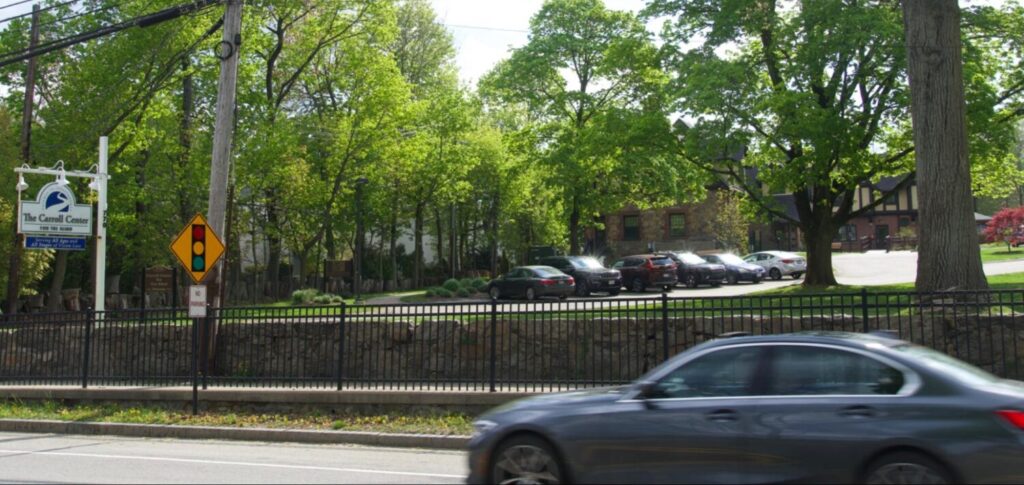
Founded in 1936 as the Catholic Guild for All the Blind, the organization originally functioned as a service network for blind residents across Greater Boston. It offered financial aid, clothing, reading circles, employment assistance, talking books, and transportation assistance. In the decades since, it has served generations of clients, often unnoticed by the traffic passing by on Centre Street.
On May 1, three clients completed the Center’s assistive technology program.
Izzy Bermudez, an assistive technology instructor, introduced the first graduate of the ceremony, Christine Demers.

Demers’ journey to the Carroll Center began a few years ago. She had developed a case of Stargardt’s disease, a rare eye condition that causes slow, progressive loss of vision.
“Normally, it affects people when they’re kids, but for some reason it decided to stay dormant in me until I was an adult, and then came crashing down,” Demers said. “Over the last year, my vision has decreased significantly, which brought me back to that scared, isolated feeling, not knowing what to do.”

Bermudez praised her persistence throughout the program.
“Your transition from a visual typist to an eyes-free navigator is a master class in resilience,” Bermudez said. “You’re not just a contact-center manager with 20 years of experience. You are now a digital pioneer.”
Demers said the Carroll Center gave her a sense of renewal she could not have imagined before entering the program. She credited Bermudez for being patient and helping build her confidence, even during moments of frustration while learning programs like Siri and Meta’s assistive technology tools.

Bermudez also recognized fellow graduate Joe Elias, who was unable to attend the ceremony.
David Kingsbury, another assistive technology instructor, introduced the ceremony’s third and final honoree, Bill Taube.
Taube was diagnosed with macular degeneration in October 2015. He came to the Carroll Center for the first time in January 2020 to take a functional reading test.

Taube said when he returned again six weeks ago, he referred to himself as keyboard- and keystroke-challenged to Kingsbury.
“Believe it or not, it’s been a lot of fun,” Taube said. “When I told him that this morning, he [Kingsbury] said I’m the first person who’s ever said that.”
Kingsbury said he convinced Taub to incorporate some keyboard typing into the program alongside dictation exercises using Google Docs and Microsoft Word. About halfway through the program, Taube told Kingsbury he needed to write something down. Kingsbury suggested dictating it, but Taube insisted on typing it himself.
Kingsbury commended Taube’s work ethic.
“A couple things about Bill, he does not give up. He would go back to his room and practice stuff,” Kingsbury said. “Second thing, and this is essential when you are trying to learn technology, he knows how to laugh.”
Another stop on the tour was the Manual and Sensory Arts department, an art studio that helps clients strengthen nonvisual and tactile skills through long-term art projects across a variety of media.
Two clients worked quietly on art projects in the studio. One shaped a mug designed to match a teapot, a process that had already taken several weeks. Once completed, the piece will be fired in a kiln at roughly 2,000 degrees to create a ceramic finish.

Some clients had worked on a model of the region’s transportation system with grooves for each transit line, using touch to better understand how to navigate across Greater Boston. The finished piece hung prominently on the wall of the studio.

Just around the corner from the Sensory Arts department is the adjustment counseling room.
Donnelly said the Carroll Center for the Blind employs a full-time social worker and health coordinator. Donnelly said many clients struggle emotionally after losing their vision, with some turning to alcohol or drugs while experiencing depression and isolation. For some, he said, it can take years before they eventually arrive at the program.
When Demers first started the workplace computing program six weeks prior, she was not sure if she could do it since it seemed too long a time away from her family.
“To now, not wanting this to end,” Demers said. “I never realized how many friends and how many lives that I would come in contact with that share the same journey.”
Dara Dalmata, the Center’s chief development and communications officer, shared some parting thoughts for this particular round of graduates.
“What we always say here is it’s not goodbye forever, it’s just goodbye for today, because we expect that and hope you will be connected to us for a long, long time,” she said. “We’re always here for more training.”
The Carroll Center will host its annual Walk For Independence on May 30 at the Charles River campus of UMass Amherst in Newton.