




Members of the Massachusetts Native Fish Coalition (NFC), MassWildlife, and Newton Conservators joined forces on Saturday morning, May 9, to re-introduce native fish into the City Hall Ponds.
In 2024, the fish population in the City Hall Ponds was nearly wiped out when the City pumped the fish into Bullough’s Pond in order to drain and dredge the City Hall Ponds for sediment removal.
Over 900 hours of eDNA (environmental DNA) testing had been done to determine the number of fish remaining in the City Hall Ponds, and it “came up with like ten fish,” said Bob Mallard, Executive Director of the Mass Chapter of the NFC.
“This [transfer of fish] is needed because fish biodiversity and biomass dropped notably due to the de-watering project, leaving the ponds unbalanced and unhealthy from an ecological perspective,” according to the Request for Determination of Applicability filed by the NFC for the project.
“[The City Hall Ponds] will become healthier ponds if they can get their fish back,” said Katherine Howard, President of the Newton Conservators.
Although the waterways in Newton are connected – flowing from Cold Spring Park to Newton Cemetery ponds, City Hall Ponds, Bullough’s Pond, and Laundry Brook to the Charles River – movement of fish from one body of water to another is difficult because barriers and culverts interrupt natural migration routes.
The goal on May 9 was to catch 20 native fish in Bullough’s Pond and relocate them in the City Hall ponds.
The night before, the NFC had set out traps baited with dog food and tuna fish. One participant speculated that the fish might avoid the canned tuna because it served as a grim reminder of what happens to caught fish.
Most of the fish traps came up empty, which was disappointing but not entirely unexpected. It was a chilly day, which made the fish sluggish and sink down to the warmer water near the bottom of the pond, moving away from the shallower areas near shore where the traps were set.
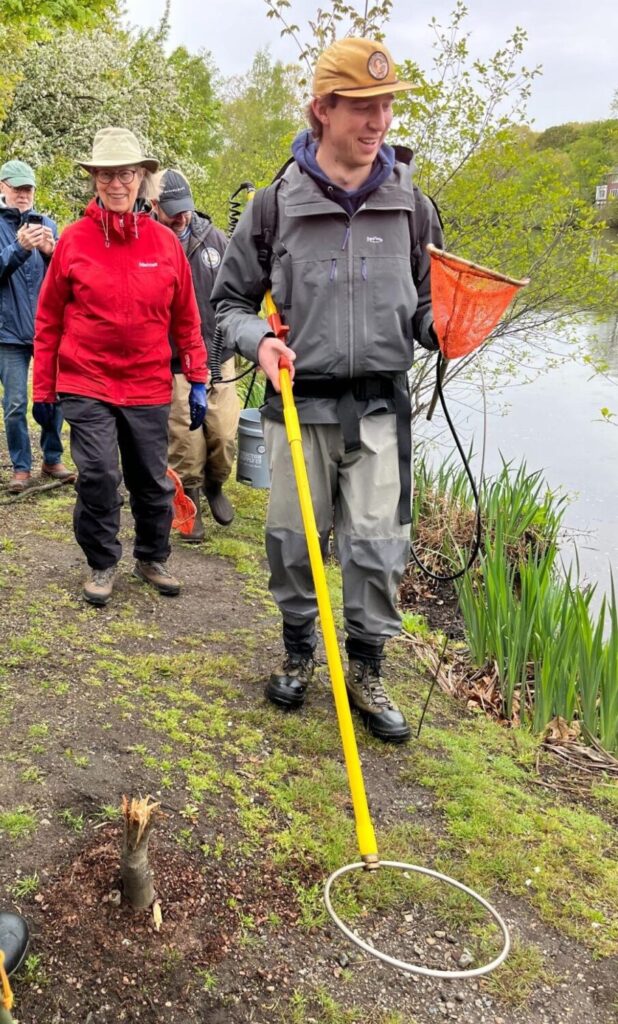
Since the traps did not yield many fish, the participants escalated their efforts by deploying the electrofisher. Ben Heinze, the Vice Chair of the Mass NFC, strapped on a Ghostbusters-looking backpack and entered the water, sweeping an electrified wand in front of him, searching for “volunteers.”
Electrofishing works by emitting an electric current that causes fish to involuntarily swim toward the device. When they come into contact with the wand, they are temporarily immobilized by an electric shock.
The fish relocation team explained that the electrified fish were not injured, just stunned, and that they would recover in a few minutes. They might experience “a little memory loss,” said one participant, “[but] they didn’t have so much memory [to begin with].”
The group discussed the difficulty of identifying native Pumpkinseed fish versus the non-native Bluegill Hybrids. Each tiny fish was closely examined to see if it had the mark of a Pumpkinseed fish – a bright red or orange spot near its eyes. Non-native fish were returned to Bullough’s Pond. Native fish were put in an aerated tank for transport to the City Hall Ponds.
The electrofishing produced impressive results: The final tally was about 23 Pumpkinseed fish and 7 eels. (This was the first time this reporter had ever cheered to see an eel.)
Everyone enjoyed watching Emily Bastian, NFC’s National Chair, try to extricate the slippery eels out of the aerated tank in order to put them in the specialized eel conveyance (a plastic bucket).

Once all the fish were divided into three buckets (one for each City Hall Pond), a caravan of pickup trucks drove the two minutes to City Hall and emptied the fish into the three ponds.


Satisfied with the day’s catch, a group had its photo taken in front of City Hall.
Mission accomplished.
