




The fourth iteration of the LigerBots Adaptive Engineering summer internship culminated on Friday, August 21 with presentations by student participants.
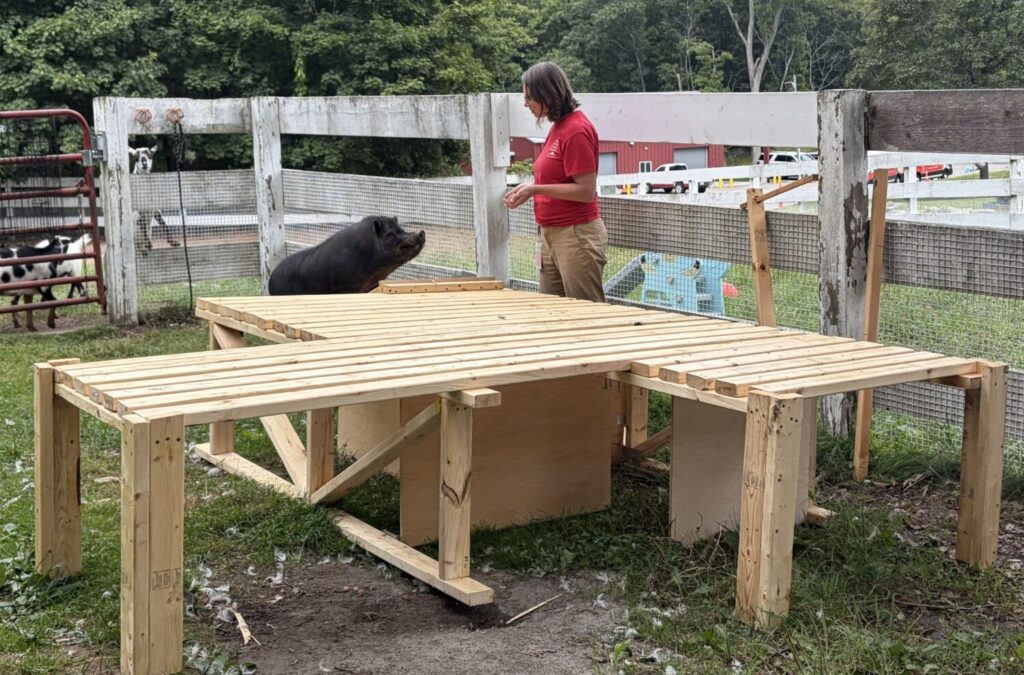
Each of the four groups spent eight weeks designing, constructing, and refining products for different clients: the Carroll Center for the Blind, children with cognitive and physical disabilities at New England Pediatric Care, a visually impaired individual, and a rescue potbelly pig.
Volunteer LigerBots coaches Greer Swiston and John Sangiolo created the summer program to provide high schoolers with an opportunity to continue their engineering education during the summer. They partnered with Northeastern University for the first two years of the program, and now they rely on generous donors to fund the internships.

Swiston said that each project focuses on creating a product that will improve the client’s quality of life.
“There are products that perhaps there’s not a big enough market for it to be commercially viable, but it sure as heck would make [that particular client’s] life better,” she said.
One team partnered with the Carroll Center for the Blind to continue developing an upper-body obstacle navigation device that last year’s group had started. Newton North junior Alyssa Yasuhara, who has been working on the device for two years, said that she made sure to be in constant communication with the Carroll Center throughout the build process.
“Every time we finish a prototype, we always like to go back to the Carroll Center to get the members’ feedback and also understand if we’re really going in the right direction, because the most important thing to us is that we’re fulfilling the client’s needs,” she said.
The team’s final project consisted of a small sensor mounted near the chest that detects upper-body obstacles above what a traditional cane would be able to detect, as well as a watch that provides haptic feedback to alert the user of those obstacles.
Newton South junior Eren Safar’s group also worked with a visually impaired client to develop distance-detecting sensors for a wheelchair so the client would be able to avoid any objects that come within the range of the sensors. Safar said he found the program to be a real test of whether his engineering skills were transferable to the problems of real clients.

“I thought that this would be a great opportunity for me to not only improve my engineering skills and software skills, but also to put them to the test and see if I can actually build something that would not just be good on paper, but actually be good in real life,” he said.
Newton South senior Jerry Gong, the founder of Lazer Robotics, said a highlight of the program is how it builds on the engineering he does during the school year.
“This was Lazer Robotics’ third year doing this program, and each year we learn a lot from our experiences in the prior year, as well as from the clients we work with,” he said. “This is an amazing program that combines the engineering we do on a robotics team with real life needs for clients in the real world.”
Gong and his team of Lazer Robotics members partnered with New England Pediatric Care to build a switch-activated, accessible wind-tunnel toy that uses a fan to push objects through a tube, creating a visually stimulating toy for residents to use.
The final group partnered with the Animal Rescue League of Boston to create an engaging puzzle feeder for a traumatized potbelly pig, to aid in preparing it for adoption. The apparatus consisted of a ramp, scratching posts, buttons, and an interactive food dispenser.

After finishing the summer internship, Yasuhara expressed her appreciation for the insight the program has given her about possible career paths.
“What we’re doing is really impactful, and I love the work that I’m doing right now,” she said. “[The program] also has helped me develop my passion for engineering, specifically assistive technology and assistive engineering, and it’s opened my eyes to a possible future in medical technology development. I’m really grateful that I was introduced to this program.”