




Newton residents support young people in several communities in Africa through health programs, education, and career development managed by longstanding nonprofits with close ties to Newton. These efforts face growing uncertainty as federal funding for international aid has been cut. Fig City News has explored the situation with three nonprofits – Nurturing Minds, Young Heroes, and Communities Without Borders – through the eyes of Newton volunteers.

Nurturing Minds and SEGA
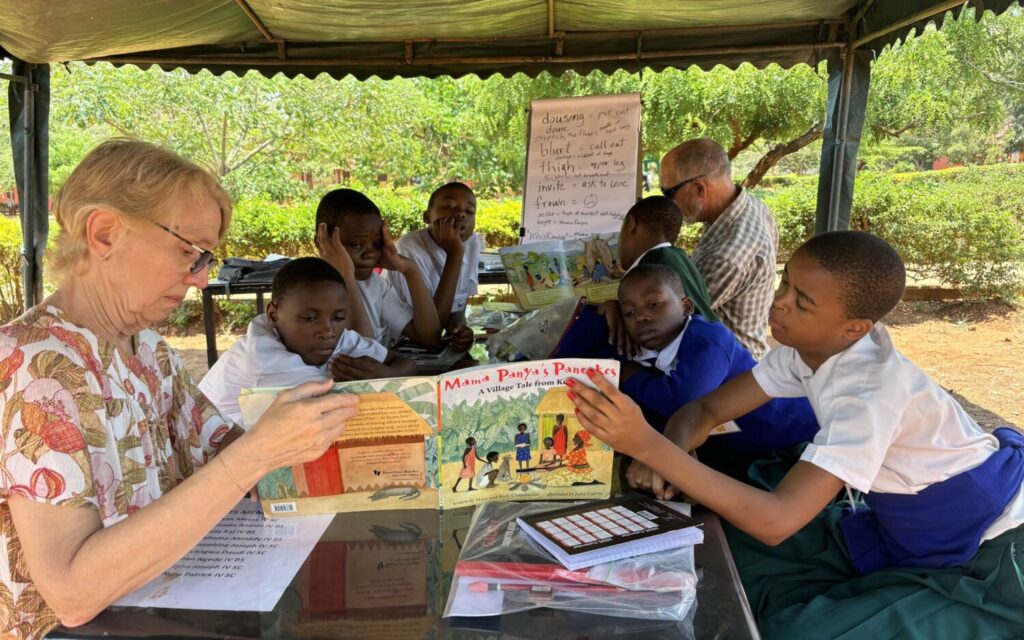
Mornings at the Secondary Education for Girls’ Advancement (SEGA) begin with routine. Dr. Linda Powers has travelled twice to SEGA as a volunteer to teach English. Every morning, girls ages 12 to 14 would run up to greet her, asking to carry any of the items she was holding. She said they were eager to learn.
SEGA is an all-girls boarding school in Morogoro, Tanzania. The school opened 18 years ago alongside the U.S.-based nonprofit Nurturing Minds. Together, the organizations invest in the development of underserved girls from Tanzania.
More than 7,000 miles away, in a Newton café, Powers reflected on those moments.
“I just learned what incredible kids they are,” she said. “They are working so hard for a goal.”
Nurturing Minds Executive Director Laura DeDominicis said adding a three-month English immersion course for incoming students a decade ago significantly improved outcomes for the girls. Since then, about 80% of SEGA students go on to college, compared to roughly 3% nationally in Tanzania.
“Traditionally, if a family is poor, they can only afford to send one child to school. They are going to send a boy,” she said.
In Tanzania, girls tend to work as domestic laborers or pursue early marriage, which is seen as a financial opportunity as families receive a dowry in return. Regardless, DeDominicis said, families recognize education as a path out of poverty.

DeDominicis described the story of Maria, who grew up in a remote village and moved among four different elementary schools. When her family relocated she stayed with relatives to continue her education. By 18, she had started high school at SEGA.
Now Maria is in her fourth year of architecture school. Maria’s father now relies on her insight and sees her as a leader in their community. She hopes to one day design sustainable housing for her community.
“A lot of these girls want to be doctors,” Dr. Powers said, “because they know the doctor in their village, and they know that’s a respected person who helps people.”
DeDominicis said internship programs play a key role in expanding career opportunities. Students from rural villages in Tanzania often lack access to professional networks.
“We’re trying to build that bridge now,” DeDominicis said.
DeDominicis said a once-active Northeast chapter of Nurturing Minds, made up largely of Newton residents, has diminished in recent years.
“A lot of women went back to work, and some people moved away,” she said. “We don’t have that strong of a local chapter anymore.”

Young Heroes
Michael Lipton, vice president of the Young Heroes Foundation, traced the roots of Young Heroes back to the HIV/AIDS epidemic that devastated communities across parts of Africa in the 1990s. The organization was founded by Steve Kallaugher, who served in the Peace Corps and was posted to Eswatini.
“He was there during those terrible times when everybody was dying,” Lipton said.
While in Eswatini, Kallaugher worked with the country’s Ministry of Health to address a growing crisis: thousands of children left without parents or consistent care. He launched an independent effort, Young Heroes, to try to meet their needs.
Kallaugher and a small group of volunteers identified children in need, connected them with local caregivers, and raised funds to support them.

In 2003, George W. Bush launched the President’s Emergency Plan for AIDS Relief (PEPFAR), a major U.S. initiative that has been credited with saving millions of lives.
But recent cuts to international aid have begun to reduce funding for these programs, raising concerns about their sustainability.
Lipton said the needs remain significant, particularly for children who have lost parents or face ongoing risks such as poverty and gender-based violence.

Years ago, Lipton and his wife sponsored a 17-year-old boy who was living alone in a remote mountain homestead after losing both his parents and his siblings. With no caregiver, he was responsible for himself. When Lipton and other volunteers visited him, one of the biggest barriers was simply getting to class. Lipton began covering the cost of his bus fare.
Today, the boy is a man. Now in his late 20s, he works as a security guard in the U.S. Embassy in Eswatini. He has a family of his own – and has stayed in touch with Lipton’s family, including Lipton’s wife, whom he calls “mom.” He also gives back, supporting other children in the Young Heroes program.
“He’s a success story,” Lipton said.

Communities Without Borders
In 1999, at the height of the HIV/AIDS epidemic, Newton resident Dr. Richard Bail was recruited by the United Nations AIDS program to travel to Zambia.
There, he worked with a team of health professionals to assess how the country’s public health system was responding to the crisis. Over several months, they analyzed government spending and developed recommendations aimed at expanding access to care.
When Bail returned to the United States, he began to focus on how to connect communities here with caregivers supporting orphaned children in Zambia. He founded Communities Without Borders (CWB) to make these connections and provide opportunities for the human potential he saw there.
Peter Smith, who was then chair of the Social Action Committee at the First Unitarian Universalist Society in Newton (FUUSN), said the church saw an opportunity to align its mission with Bail’s work.

Over several years, groups of FUUSN volunteers – ranging from teenagers to retirees – have traveled to Zambia to work alongside local communities, teaching in schools and building relationships through shared activities. Participants have come from a wide range of backgrounds, including carpenters, lawyers, and musicians.
The organization has mainly contributed to the Sekelela Community School in Mwembeshi, Zambia. When volunteers first arrived, the school had just four teachers – many of them unpaid – serving roughly 150 students.
“They needed all kinds of support,” Smith said. “The tops of the desks were falling off.”
The organization works with local partners to address those challenges, helping to stabilize staffing and improve facilities. Currently, the school serves approximately 700 students.
New classroom buildings, including a science and computer lab, are now nearing completion. The new building also contains secure storage, teacher rooms, and a kitchen facility to enable community members to prepare daily meals for students and staff. Communities Without Borders is funding it through the Dick Bail Fund, a capital campaign honoring CWB founder Dr. Richard Bail, who passed away in 2019.
Communities Without Borders operates independently of U.S. government funding.
Loss of USAID Funding
In Tanzania, DeDominicis says relatively modest funding can support education, housing, and basic resources that would be far more costly in the United States. DeDominicis said Nurturing Minds and SEGA received four grants in their early years through the American Schools and Hospitals Abroad program, under USAID.
SEGA had anticipated receiving a fifth grant last year, but cuts to USAID programs meant losing roughly $500,000 for infrastructure and program improvements.
In 2023, Young Heroes received a three-year USAID grant to support its programs for children and families affected by HIV. The program employed roughly 750 staff members – most of them based in Eswatini – who worked directly in villages supporting thousands of children.
“That all got cut off overnight,” Lipton said.
Despite the setbacks, Lipton said the organization continues to operate, relying on alternative funding sources to sustain its work.
“We’re still collecting money from other sources,” he said. “We’re still helping out lots of kids.”
Lipton said programs like Young Heroes have also played a role in building goodwill toward the United States in the communities they serve.
“This program was doing America a lot of good, a lot of respect, and leading to a lot of business,” he said. “The money we’re talking about, comparatively speaking, for the U.S. budget, is minuscule.”
Gratitude
Dr. Powers said her experience volunteering for SEGA has expanded her understanding of life.
“I was really happy to see the attitude of people, the warmth of people who welcomed me. It was just a lovely experience,” she said.
Lipton said despite everything that the Eswatini people have dealt with, they remain positive people.
“You will not meet anyone happier or friendly than the Swazi people,” he said. “They are grateful for their life and everything they have.”
Those looking to support these programs can explore online via these links: