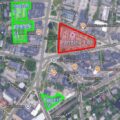




When three contiguous parcels (206-208 Concord Street in Lower Falls) were put on the market at the same time, Lower Falls resident Tori Zissman began to worry about the possibility of a developer tearing down the existing homes to make way for a new, larger project. Zissman, who had long admired the historic nature and cohesiveness of the Lower Falls village, decided to discuss the situation with then-local activist Randy Block, who currently serves as Ward 4 City Councilor.
“At that time, Randy Block was not the Councilor — he was with RightSize Newton — and so I just brought it to his attention and said, ‘seems to me like there’s potential here for somebody to build something really big on this, if they pull these all together, if they buy them all,’” she said. “And it was Randy who suggested, ‘Do you think we could landmark it?’”
The landmarking process
Newton’s Local Landmark Ordinance, which was first enacted in 1993, is a little-known but powerful tool to protect historic structures and properties. The ordinance empowers the Newton Historical Commission (NHC) — a body of seven volunteer members appointed by the Mayor — to designate buildings as “local landmarks,” effectively blocking alteration of their exterior and setting without NHC review. Today, 31 properties in Newton have landmark status.
Landmark status grants a property the highest level of protection available in the city. While the National Park Service maintains a National Register of Historic Places, being listed on the Register does not come with any specific protection. The same is true for properties listed on the Massachusetts Historical Commission’s database of historic properties, the Massachusetts Cultural Resources Information System.
In order for a property to qualify for landmark status, the Commission must deem it to be “historically significant.” According to the Commission, such properties are, among other things, “importantly associated with historic person(s) or event(s) or with the architectural, cultural, political, economic, or social history of the City,” or “historically or architecturally important for their period, style, method of construction, or association with a particular architect or builder, either by themselves or in the context of a group of buildings or structures.”
Any property owner may nominate their property for consideration, but City Councilors, the Mayor, the Director of Planning and Development, and the Commissioner of the Inspectional Services Department have the power to nominate any property they wish — as long as they have one co-petition from an NHC member.
As Zissman navigated the landmarking process for the first time, alongside friend and fellow Lower Falls resident Cyrisse Jaffee, she ran into some logistical challenges. Zissman called it “a real learning experience.”
“It wasn’t straightforward. You look at the City website, and it’s not totally clear what the process is, what the steps are,” she said.
Chief Preservation Planner David Lewis, who staffs the NHC, said that the process has two main steps. First, the Commission holds a preliminary vote to decide whether or not to accept a nomination and continue the review process. Then at a later date, a second vote determines whether or not a nominated property should receive landmark status.
A range of opinions
While landmarking advocates argue that the designation is a method for preserving history and maintaining neighborhood character, others have concerns that the process can be misused to block what they view as reasonable development.
Zissman and Jaffee have worked with various City Councilors and NHC members to get landmark status for two Lower Falls properties: the aforementioned 206-208 Concord Street — also known as the Crane House — and, most recently, 55 Pine Grove Avenue. In addition to Block, the pair also worked with former City Councilor Lenny Gentile (Ward 4) as well as former NHC member and current Chief Community Services Officer John Rice.
Having conducted several joint walking tours of Lower Falls, both Zissman and Jaffee have a deep interest in local history. For Zissman, landmarking is a way to make history more “proactive.”
“We always seem to be in a reactive mode, where the property is in danger. [Landmarking] is one method for making the community aware of the history of the property and bringing history into that conversation,” she said.
Jaffee said that landmarking is an important tool for preserving what she views as one of Newton’s greatest assets: historic properties.
“I think it’s kind of ironic that some people are resistant to the idea of landmarking, and yet one of the reasons people love to move to Newton is its historic character,” she said.
However, Jaffee also said that it is important to be discerning when it comes to granting landmark status.
“We’ve seen things come and go, and as we both always acknowledge, not everything is worth preserving,” she said. “It’s not sort of a ‘don’t touch the neighborhood’ feeling. It’s, ‘let’s think about what this property or this space is about.’”
Zissman said that she has often encountered what she calls a misperception that preservation advocates like her want to see the Local Landmark Ordinance applied thoughtlessly, on a large scale. The reality, she said, is more nuanced.
“There’s criteria that the house has to meet. We can’t just landmark things willy nilly, nor would we want to: because the neighborhood is rich, because it has all these different layers of experience and all these different lives that have been lived here, and you can see traces of that all over,” she said.
Block has a similar perspective. A history major in college, he said that preservation comes naturally to him.
“Newton is a very old town. A lot of things happened here that are historic, over the centuries, literally, that Newton has existed. A lot of the early structures or important structures no longer exist, for whatever reason. But still, I feel that we could do a better job as a community to identify buildings that have real historic value and be more aggressive in landmarking them,” he said. “That’s the historian in me talking.”
Concerns about landmarking
In a statement to Fig City News, Charles River Chamber of Commerce representative Max Woolf said that while landmarking is an important tool for preserving Newton’s history and character, it can also be co-opted to stall or prevent thoughtful redevelopment.
“One challenge is that the process can rely on subjective criteria. When there is strong anti-development sentiment, a mechanism intended to protect truly historic assets can instead become a way to block sensible development,” he said. “In our suburban region — we are not Florence, Italy — many of the most historically significant buildings are already protected. Thus at times, there have been questionable landmarking efforts, including past attempts to designate a gas station.
Fortunately, we have largely avoided the more contentious landmarking battles seen in places like Cambridge, where the process has sometimes been used in efforts to block even 100% affordable housing developments.”
Zissman said that she has often heard concerns that homes with landmark status are harder to sell or decrease in value when put on the market.
However, local realtor Ingvild Brown said that the reality is less black and white. While some buyers may want to avoid homes with landmark status, she said, the biggest factor behind the value of a home is simply its quality.
“It does affect buyer demand to some degree because some buyers may be concerned about the limitations for renovations, for instance, or upgrades,” she said. “It’s basically an issue that is very individual from house to house, depending on how well the house has been maintained, how well insulated it is for energy purposes, things like that.”
Ultimately, Brown said, landmark status does not necessarily outright affect one’s ability to sell an up-to-date home, especially given that the interiors of landmarked properties can typically be easily altered.
Demolition delays and historic districts
In addition to its landmarking powers, the NHC also has the ability to regulate Newton’s four Historic Districts (Auburndale, Chestnut Hill, Newtonville, and Upper Falls) as well as demolitions in the city.
Historic districts are distinct from local landmarks in that the former refers to, according to the Commission, “areas of historic and/or architectural value in which historic buildings and their settings are protected by public review.” Local landmark designation, on the other hand, is given simply to individual buildings.
Additionally, the City’s 1985 Demolition Review Ordinance allows the NHC to place a delay of up to twelve months — and, in the cases of properties listed or eligible for listing on the National Register, eighteen — on the demolition of a historically significant building.
Some, like Block, want to see that power expanded. Block said that he would be happy to see demolition delays of up to two years.
“The Historic Commission doesn’t vote to preferably preserve a building on a whim,” he said. “They have concrete information in front of them, and if there is a reason why they voted to preferably preserve it, then I think a significant demolition delay to try and encourage the owner, whoever the owner is, to preserve the building — and if they need more space to renovate the building or to add on to it in a way that doesn’t alter the appearance from the street — is a very good thing.”
Lewis said that the purpose of a demolition delay is to give time to consider alternatives other than demolition.
“It allows for the opportunity to take a pause and look for other options,” he said. “Sometimes, that’s a partial demolition. Sometimes, that can be moving the property. It can, conceivably, be selling the property to somebody who’s maybe interested in preservation instead of a demolition. There are a variety of outcomes.”
Lewis acknowledged that the power of the Demolition Delay Ordinance is limited.
“People can obviously wait out the delay. And that’s sort of the limit of our powers …At the end of the day, for most properties, people can wait that year out and do whatever they want,” he said.
Lewis also said that it is challenging to know exactly how effective demolition delays are from a preservation perspective, given the vast amount of data.
“We just don’t have the bandwidth to go through and track every single property in terms of how many of them ultimately get demolished when they come before demolition delay,” he said. “So it’s hard to quantify exactly how much the delay prevents demolition as a whole.”
However, Lewis said that the NHC has seen many of what he called demolition-delay “success stories,” which involved property owners and architects working with the commission to develop designs that fit better in the architectural context of the neighborhood.
Multi Residence Transit (MRT) zoning
Lewis also said that the City’s new Multi Residence Transit (MRT) zoning, which was adapted as part of the Village Center Overlay District (VCOD) zoning update, has been “the most significant thing” driving preservation success, as opposed to simply switching to a partial demolition.
Current MRT zoning allows for an existing large building to be converted into up to six units; it also allows a 50% addition. However, MRT zoning represents less than 2% of the land in the city.
In a January 23 meeting of the City Council’s Zoning and Planning Committee, City Council President John Oliver and Councilor Pam Wright presented several initiatives they had in mind to encourage preservation — and one included expanding MRT zoning.
Wright suggested creating a path for large homes to be converted into up to 4 units by-right, allowing for a “modest” addition off the back as well.
“It’s meant to be city-wide or available to any lot on which there’s obviously a large home, and that’s why it’s slightly different from MRT in the number of units,” Oliver said. “But I think that there’s a reason why people are adopting MRT, and we seem to have struck on something there that is popular.”
In a March 3 newsletter, Charles River Chamber of Commerce President and CEO Greg Reibman voiced approval of Oliver and Wright’s idea.
“[The idea] could boost the supply of smaller, more affordable homes for those younger families, while also advancing climate goals and curbing teardowns,” the newsletter read in part.
Theo Younkin is a Fig City News student reporter, a senior at Newton South High School, and former Co-Editor-in-Chief of the NSHS Lion’s Roar.