




Amid efforts to expand fair housing in the city, the Newton Fair and Affordable Housing Partnership honored Josephine McNeil and Jini Fairley with this year’s Sheila Mondschein Award “for outstanding leadership in promoting fair housing.”
Dozens of public officials, civic leaders, family, and friends gathered in War Memorial Hall at Newton City Hall on April 23 for the ceremony. Mondschein, who died in 2018, was a founding member of the city’s Fair Housing Committee and a leading expert on the Fair Housing Act in New England.
Josephine McNeil
Marva Serotkin, chair of the Newton Fair and Affordable Housing Partnership (NFAHP), introduced Josephine McNeil by noting that many across the city know her simply by her first name due to her decades of effective civic engagement.
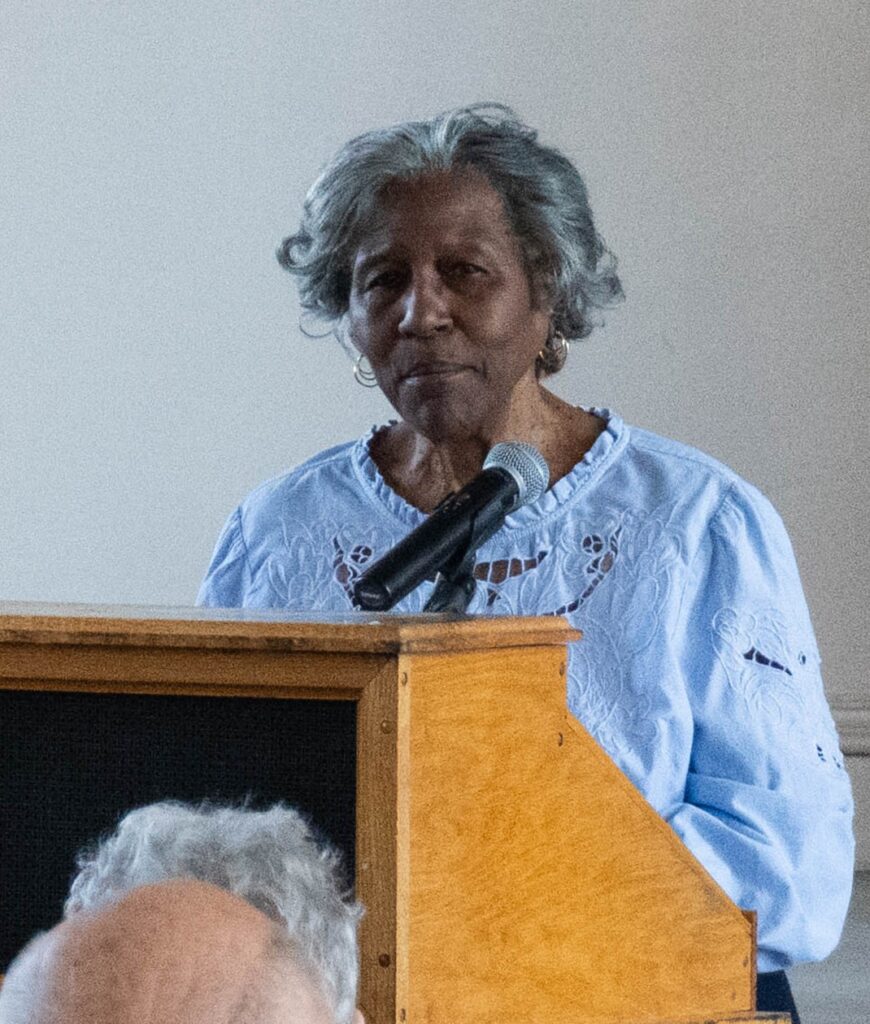
For more than 20 years, McNeil has served as executive director of Citizens for Affordable Housing in Newton Development Organization (CAN-DO), with a brief retirement in 2017. She also serves on the NFAHP, which was recently formed through the merger of the Fair Housing Committee and the Newton Housing Partnership.
“As an attorney, she understands that there is no bright line between affordable housing and fair housing,” Serotkin said.
In her remarks, McNeil said that despite some progress, housing in Newton remains too expensive. Many essential workers, she said, still struggle to live in the city they serve. Those workers, she said, include childcare providers and aides who assist older residents, including herself.
“All of those people are the people we need as a society,” she said.
Enacted on April 11, 1968, as part of the Civil Rights Act, the Fair Housing Act prohibits discrimination in housing based on race, religion, sex, national origin, familial status, or disability. The law applies to landlords, real estate companies, and public entities such as municipalities.
McNeil said the act must be strengthened to better serve low-income residents. She added that the City should put systems in place to help people earning below 50% of Area Median Income move into Newton, with continued financial support and oversight from local authorities.
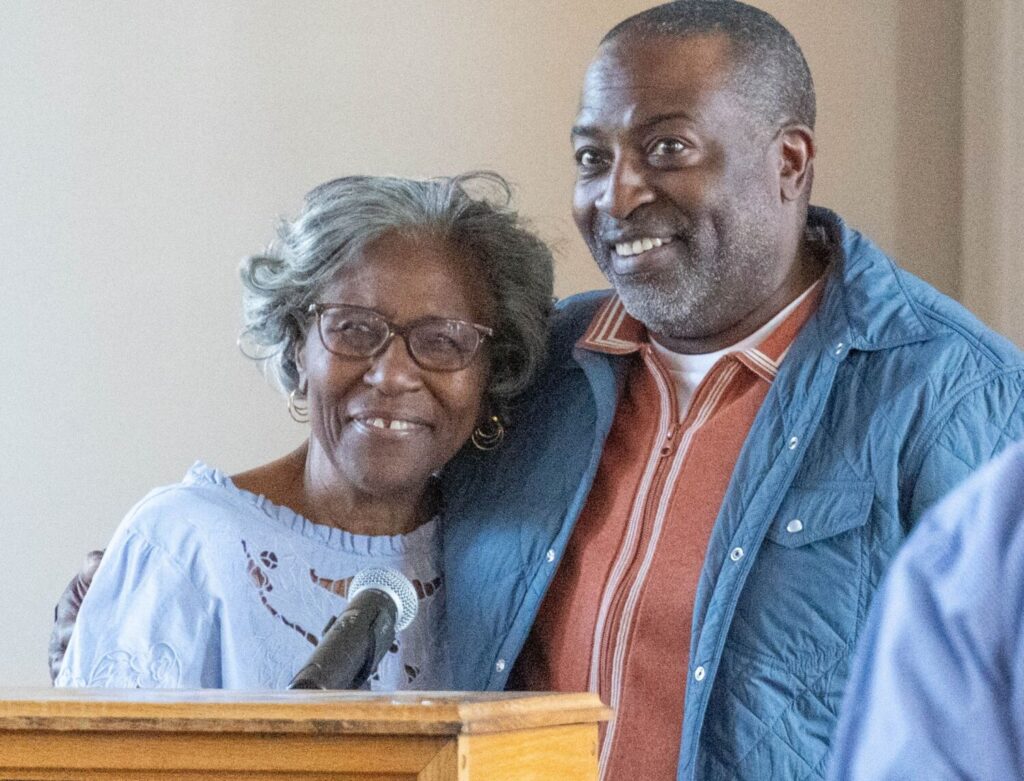
As McNeil neared the end of her speech, she looked across Memorial Hall and saw her son, Michael, who had traveled from New Jersey for the event – an unexpected sight that caught her off guard.
Jini Fairley
Jini Fairley approached the podium with her guide dog to receive her award. After developing retinitis pigmentosa in her 30s, she continued working and advocating for the disability community. She retired in December after a decade as Newton’s ADA coordinator.
Fairley said she has experienced the difficulty of finding affordable housing firsthand.

She grew up poor as one of four children. Her father, a World War II veteran, moved the family into veteran housing a few years after returning home, and they spent a decade in public housing in Providence, Rhode Island. Her parents had never owned a home, and after her father’s death, her mother struggled to afford rent on their duplex. She relied on a small teacher’s pension and limited Social Security benefits until qualifying for a Section 8 housing voucher.
“I was thankful she didn’t have to move away from that house,” Fairley said.
Fairley emphasized her work advancing accessibility in Newton, noting how efforts to support people with disabilities often intersect with the broader fight for affordable housing. She explained that the Fair Housing Act was amended in 1988 to include disability as a protected class.
She noted that disabled residents continue to face significant housing hurdles, and said it is common knowledge that many disabled residents are unemployed and struggle to rent housing.
According to Fairley, the largest share of housing discrimination cases involve disability. She said the provision of “reasonable accommodation” in the Fair Housing laws tends to be misinterpreted. Despite the existence of disability protections for more than 35 years, she said discrimination remains widespread.
Robert Solomon, a longtime accessibility advocate who has worked closely with Fairley, attended the event to celebrate her. One of the most significant projects they have worked on together, he said, focused on expanding wheelchair accessibility across a large share of government buildings.
Solomon said Fairley also helped him advocate for his own accessibility needs in his apartment, including teaching him the terminology needed to secure accommodations.
“Reasonable accommodation is like magic,” Solomon said.
Fairley also praised her fellow honoree, McNeil. She said McNeil has been a mentor to her for nearly 11 years and will continue to be. She said she has received countless emails from Josephine with helpful information on webinars, legislation, and more on fair housing over the years.
Fairley said she had worked with Mondschein for three years, attending monthly Fair Housing Committee meetings as an advisor in her role as ADA/504 coordinator.
“She was my first Fair Housing mentor,” Fairley said.
Fairley recalled a moment during a training session for the Zoning and Planning Committee and other City Councilors, when Mondschein turned to her to ask about accessibility requirements. Fairley said the exchange taught her the importance of engaging others and bringing them into the conversation. Fairley became emotional as she quoted a line from a poem, “We Remember,” written for Mondschein’s obituary: “When we have achievements that are based on hers, we remember her.”
Fairley said she hopes the City will soon hire a full-time ADA coordinator. With only an interim coordinator currently in place, she said, there is still significant work to be done to meet accessibility needs of residents across the city.