



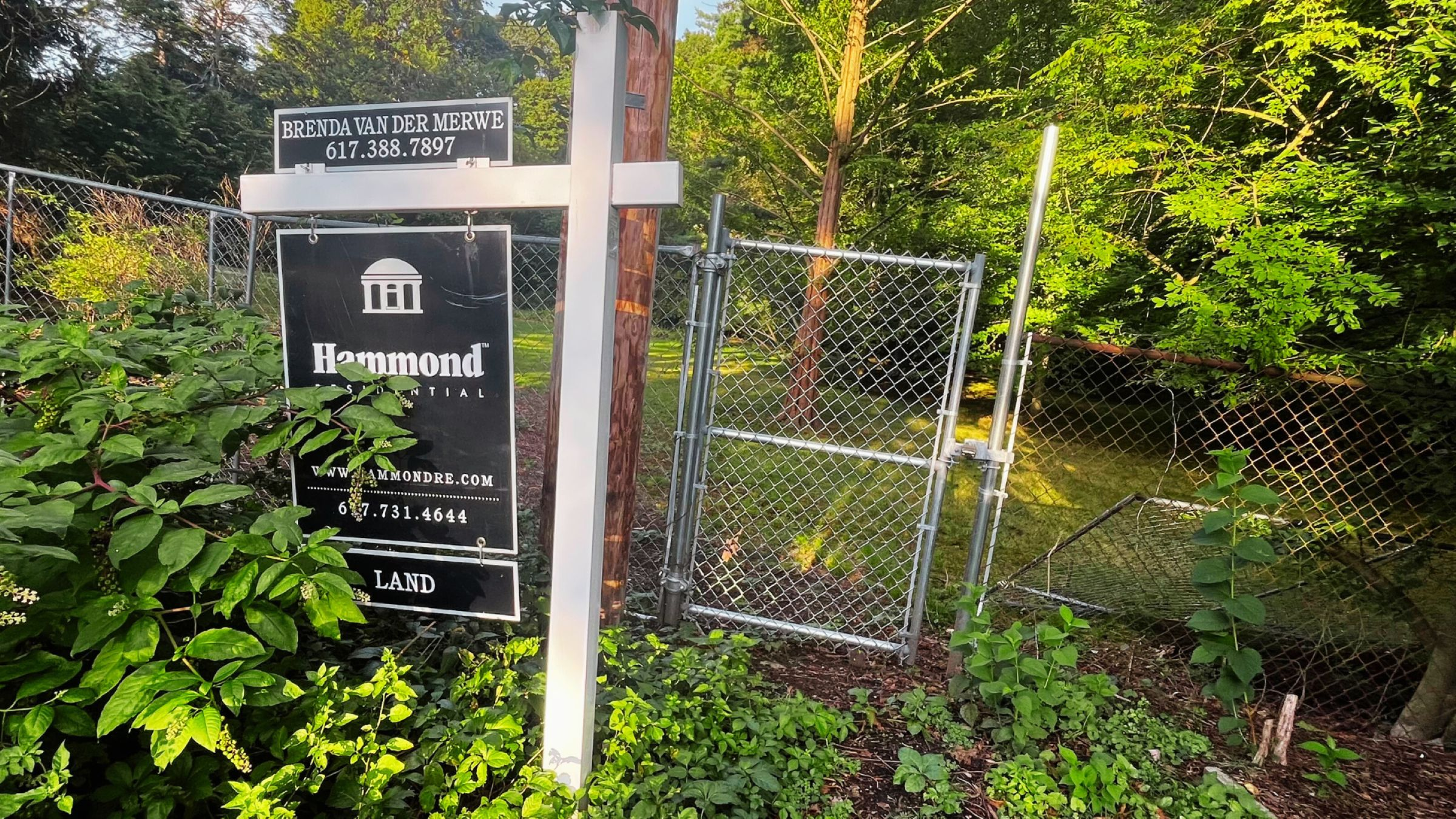
On July 13, the City’s Board of Survey voted to continue discussion later on a controversial agenda item: a proposed amendment to a property subdivision on Chapin Road in Newton Centre. The proposal has sparked fierce debate, particularly over stormwater and perceived problems with the City’s process for approving changes.
For decades, the Chapin Road land was part of the backyard of a home on Homer Street. But in 2023, the Board approved a subdivision of the property, which allowed two empty lots to be put on the market.
During that initial subdivision approval process, Board members recognized that stormwater could pose a problem for development. The Chapin Road land is situated on a high water table, meaning that underground water is close to the surface. Under the City’s Stormwater Ordinance, developers are required to ensure that stormwater is infiltrated on-site: new construction may not increase the flow of runoff from the property. The Board worried that if two houses were built on the empty lots, the property would not be able to infiltrate its stormwater.
And the stormwater issue is particularly important to the subdivided lots’ abutters and Chapin Road residents: For decades, they have grappled with heavy flooding in the area. Many have installed sump pumps in their basements. One Chapin Road resident, Ingrid Schroffner, told Fig City News that stormwater has flooded her basement three times.
Ultimately, the Board voted to approve the initial subdivision — but given the stormwater conditions, their approval came with strings attached. The developer of the two lots would be required to implement a stormwater management plan, which would need to include an extension of the municipal drain down Chapin Road. In accordance with standard City procedure, that drain extension would need to come before the City Council for approval.

A developer steps forward
In 2024, Newton resident Betsy Harper purchased the subdivided lots, intending to develop them.
Harper has, by her own account, professional experience that differs significantly from that of mainstream developers: she focuses on ultra-energy-efficient projects. Harper told Fig City News in 2025 that when she purchased the Chapin Road lots, she intended to build two of these energy-efficient houses, one of which she planned to live in. Ultimately, she changed her mind about the project and decided to sell the property, while simultaneously working to prepare the land for construction. That meant requesting approval from the City Council for a main drain extension.
But her petition ignited a firestorm. Neighbors argued that Harper’s broader development plan would make the flooding in the Chapin Road area even harder to manage, resulting in devastating consequences for their properties. They joined forces to hire a lawyer and an engineering team, who issued reports that raised serious concerns about the stormwater issue.
After much debate, the Council’s Public Facilities Committee voted down Harper’s petition in December. Before her request could be referred to the full Council for a final vote, Harper withdrew the petition “without prejudice” — meaning that she could file it again at any time.
A revised plan
Now, Harper and her team are back before City officials, asking the Board of Survey to amend the 2023 subdivision that split the Chapin Road land into two lots.
“In March 2026 I attempted to resolve the impasse; I cut the potential value of my property in half and applied to the Board of Survey for an amendment to the subdivision to allow only one house, and to have all the stormwater infiltrated on-site,” she said in a July 22 statement to Fig City News.
Essentially, Harper is seeking to combine the two lots and to prove to the Board that her new subdivision plan will allow for development without resulting in additional stormwater runoff, making it compliant with the Stormwater Ordinance. In that case, the Board could remove the requirement for a drain extension — and development could commence, in accordance with the standard City process.
But neighbors say that their concerns are serious and they persist. They are asking the Board to reject Harper’s request — at least, in its current form.
Since Harper initiated the amendment process, the debate over her proposal has grown increasingly fierce. Harper, the neighbors, and both sides’ engineering and legal teams have sent Board members dozens of letters and memos. City Councilors have spoken out. Debate over Harper’s request has spanned four Board meetings, and as the process has dragged on, Board members have become visibly frustrated — and split over the right path forward.
The stormwater debate
Much of the debate between Harper and the neighbors has centered around the issue of stormwater.
When Harper and her team drew up the new subdivision plan, they included a stormwater management plan to demonstrate that the property could be developed in accordance with City regulations. In response to feedback, Harper has changed elements of the stormwater management plan a few times since she first submitted the broader subdivision plan, but its core features remain the same.
The stormwater management plan, as described in a high-level overview and complete subdivision plan that Harper submitted to the Board, calls for a multi-step, on-site stormwater infiltration process. Stormwater would be collected in two catch basins, transferred to a pump chamber, and pumped into an underground water distribution system. If water in the pump chamber reached a dangerously high level — an indication that the pumps were not working — an alarm would go off, alerting the property owner.
To back up the proposal, Harper and her team conducted a hydraulic analysis, modeling the impact of 2-, 10-, 25-, and 100-year storms. They looked at two different scenarios: one in which the lots were not developed, but connected to Chapin Road via a new roadway; and one that included the roadway as well as an illustrative house. According to Harper’s proposal, the results for both models showed no increase in peak runoff flow and volume at all. In fact, her engineers reported a decrease for the 25- and 100-year storm events, and no change for the 2- and 10-year storm events.
However, neighbors and their engineering and legal teams strongly contest Harper’s findings. They have identified what they say are problems with Harper’s stormwater management plan and engineering analysis. She disputes their claims.
Both the neighbors’ team and Harper’s team have picked apart each other’s calculations in a long series of memos. Representatives for the neighbors have submitted findings that they say show Harper’s stormwater analysis is incorrect, and that for some storm events, stormwater runoff would increase and contribute to neighborhood flooding. They also point to what they see as engineering flaws in Harper’s design, which they argue will make it impossible for the plan to be executed as intended. Harper’s team, in turn, has insisted that the neighbors’ analysis is inaccurate and misleading, and that Harper’s plan is sufficiently robust.
What size house?
Beyond the engineering battle, however, neighbors and their allies have identified several high-level concerns.
For instance, property abutters Natalie and James Noonan wrote in an undated letter to the Board that the illustrative house that Harper’s team used for their stormwater calculations is smaller than it should be, considering that if the subdivision were approved, zoning would theoretically allow for a much larger house to be built.
“The house modeled on the plans is unrealistically small, and the developer who buys this property (currently listed as under agreement) will surely build something different and bigger to sell it for the largest possible profit,” the letter reads in part. “A larger house would create additional impervious area that would increase runoff, yet this possibility does not appear to be reflected in the drainage analysis before the Board.”
Fig City News verified that Harper’s property is publicly listed as under agreement.
Additionally, on July 10, eight neighborhood households sent the Board a letter expressing concerns that Harper’s real estate agent was marketing the property as an opportunity to build a house with 10,000+ gross square footage — thousands of square feet larger than the illustrative house Harper’s team based their calculations on.
“Whether or not that particular development occurs is not the issue before the Board. Rather, the marketing underscores that the lot has been presented as capable of supporting significantly greater development than the illustrative house shown on the plans,” the letter reads in part.
The letter included a screenshot apparently of an email from a realtor to several other realtors in the area. “The FAR [Floor Area Ratio] is 33% in SR2 [a residential zoning district], so one could build a 10K+ sqft house on this gorgeous land,” the email reads in part.
However, Harper has said that any house that does eventually get built would need to demonstrate compliance with the Stormwater Ordinance.
“The actual house may be slightly larger and in a slightly different location — but not by any significant amount. The site’s physical constraints naturally limit the practical size and location of any future home. And if a larger footprint is chosen, the stormwater management system will be required by law to increase commensurately,” Harper wrote in a July 8 letter to the Board of Survey.
Additionally, in a July 22 memo to the Board of Survey backing Harper’s proposal, City Councilor Susan Albright (Ward 2) said that the neighbors’ argument regarding the illustrative house was misleading.
“The opposition’s alarmist claim that a house will be built to the maximum Floor Area Ratio (FAR) — resulting in a massive 10,000 GSF [Gross Square Footage] structure with a 5,180 square foot footprint that floods adjacent properties — is a legal and physical impossibility. A roof footprint of that size could never meet the strict retention standards of the Stormwater Ordinance,” the memo reads in part.
Engineering mechanisms
Another neighborhood claim is that on a fundamental level, Harper’s stormwater management plan simply does not make sense for a property that captures water in the ways that neighbors have observed. Multiple Chapin Road residents attest to having seen water form a seasonal pool on the property in years past.
“For decades, we have witnessed [the lowest portion of the subdivision] repeatedly pool with water — sometimes high enough for ducks to swim in the spring,” longtime Chapin Road residents Martin and Laurie Berinstein wrote in an undated letter to the Board of Survey. “The applicant’s revised stormwater proposal assumes that this low area, that often forms a pond in the spring, can absorb enough water during major storms to prevent our home from flooding. We are not engineers, but after nearly four decades living beside this property, we know firsthand how it behaves. It is difficult to understand how land that struggles to handle normal seasonal water and rainfall can absorb large storms’ worth of rainwater.”
On a broader level, neighbors also feel that after years of struggling to protect their properties from significant flooding, they should not be exposed to unnecessary future risk — especially when the only comfort offered is a stormwater management plan that their lawyer and engineers have called “unprecedented” and “untested.”
The neighbors’ attorney, Dennis Murphy, wrote to the Board in a June 29 memo, “Since this Board approved the original subdivision in 2023, it has become clear that flawed plan never should have been approved in the first place. It was conditioned on extending the municipal stormwater drain down Chapin Road. After thorough evaluation during a year of public hearings, the Public Facilities Committee could not approve the drain extension for the original subdivision because it did not meet the City’s or state standards for stormwater drainage. Now, you are being asked to eliminate that condition entirely and instead substitute a pump system that has never been successfully permitted in any residential development in the City.”
However, Harper’s attorney, Sean Regan, maintains that there is precedent for Harper’s stormwater management plan. In a July 8 memo to the Board, he wrote that the engineering firm Harper hired had designed a similar system in the past.
“The Everett M. Brooks Company prepared design plans in 1997 for a similar drainage pump design on Walnut Street in Newton — a catch-basin-to-pump-chamber system managing stormwater for a 40,000 square foot impervious lot — and there have been no known failures of that system in the nearly thirty years since. There are no differences in the pump used for a residential versus a commercial system,” the memo reads in part. “Because the ’unprecedented’ assertion is demonstrably false on this concrete example, and given that stormwater pumping is a standard engineering practice, it is reasonable to presume further comparable installations exist upon more than the cursory review we have undertaken.”
And in a separate July 8 letter to the Board, Harper herself made clear that despite reports of water pooling in the past, she is confident that engineering data supports the conclusion that her proposed plan for the subdivision will not result in increased stormwater runoff from her property.
But neighbors say that their concerns persist. They continue to draw the Board’s attention to their experiences with flooding. Their engineers continue to argue that they have never seen anything like Harper’s proposal in their decades of experience.
And now, nearly four months since Harper first submitted her plans, the process has become increasingly complex, and tensions have mounted.
Questioning the process
Several parties involved in the process — neighbors, Harper, and even Board members — have pointed out that, from their perspective, the subdivision approval process has been irregular.
For a subdivision amendment, Harper’s proposal has drawn an unusually high level of City Council scrutiny. Despite having no direct say in the Board of Survey process, over a dozen current and former Councilors have attended Board meetings, and several have spoken out.
In addition to Councilor Albright, City Councilor Alison Leary (Ward 1) has also gone on the record in support of Harper’s proposal.
“I have never seen such a robust, thorough, over-the-top stormwater plan. There is no reason why the Board of Survey shouldn’t look at this and say, ’this petitioner has made every effort and gone above and beyond to ensure that they are going to meet our very robust Stormwater Ordinance,’” Leary said at the most recent Board hearing on July 13. “And keep in mind that this is just the first step. Any building will have to meet our stormwater ordinance keeping all water on site, or they cannot build it.”
However, others — including City Councilors Tarik Lucas (Ward 2), Julia Malakie (Ward 3), Rena Getz (Ward 5), Lisa Gordon (Ward 6), and Sean Roche (Ward 6) — have voiced many of the same concerns as the neighbors.
“The site is so ill-suited for building that even an optimistic application requires such complex and potentially brittle systems, just in order to pass what should be a relatively low bar of the Board of Survey,” Roche said at that same July 13 hearing. “Ultimately, my concern here is that the risk entailed here is much larger than any potential benefit.”
Additionally, some neighbors have said that they feel the Board process has not been sufficiently attentive to their concerns. For example, email records obtained by Fig City News show that on July 16, Schroffner submitted to Board staff a memo supporting the neighborhood argument that Harper’s plan will result in increased stormwater runoff from her property. However, the memo was not included in the publicly available meeting packets given to Board members in advance of the Board’s most recent August 3 meeting, despite neighbors following up several times. (Senior Planner Zach Melcher responded on August 3 saying that he had requested that the memo be included in the August 3 packet, and that it would also be included in the meeting packet for the following meeting. As Senior Planner, Melcher’s responsibilities include staffing the Board of Survey, which is composed of members of the Planning & Development Board.)
Furthermore, neighbors have also said that they believe Board staffers’ communication with them has been unclear and misleading, pointing to confusion about one of the Board’s meetings.
A full public hearing had been scheduled for the Board’s August 3 meeting. But Harper and her team requested an extension, so the public hearing was pushed to October 15. The meeting itself was not canceled — no public hearing took place, but Board members participated in a working session to discuss the proposal among themselves.
Nevertheless, email records obtained by Fig City News show that on July 24, Senior Planner Zach Melcher sent an email to the neighbors and Murphy with the subject line “Cancelled – 8/3 P&D Board Meeting.”
“The petitioner has indicated that their Engineering team will not be available for the upcoming Planning Board meeting on August 3rd. They will also not be available for the September meeting. They have requested an extension on their application, and the hearing will be continued to October 15. Apologies for the delay in this process,” the body of Melcher’s email reads in full.
When neighbors reached out to Board member Ed Dailey to notify him of the aforementioned points, email records obtained by Fig City News show that Dailey appeared to express frustration.
“I can only say that I too am deeply frustrated by a confusing ’process,’ if it is even that,” Dailey’s response read in part.
Dailey has made similar remarks in the past. At the July 13 Board meeting, he said that he believed the Board had not received timely information from City engineers regarding more technical stormwater issues. When information did come in, Dailey said, City staff sent it “at the 11th hour.”
“This is asking us just to be sitting ducks to approve what apparently the City wants to do, not the citizens, not the Planning Board. This is not how government that serves the people should act,” he said.
Assistant City Solicitor Andrew Lee said at the July 13 meeting that he strongly disagreed with Dailey’s characterization of City staff’s intentions.
“The role of City staff is not to act as an advocate for any particular proposal. It’s not to promote it. It’s not to make it so that it doesn’t happen. The role of City staff is clear, it is objective, it is neutral. We apply the regulations, the standards, I apply the law as objectively as I can for the benefit of the City,” he said. Lee added that he wanted to state for the record that Dailey’s assertion that approving Harper’s plan “is what the City wants to do” is “simply false.”
“We’ll agree to disagree,” Dailey responded.
In an August 14 statement to Fig City News, City spokesperson Ellen Ishkanian said that the Engineering Department has been operating in accordance with standard practices.
“The City’s Engineering Department has provided all required information and review to the Board of Survey in advance of its meetings, consistent with established procedures. No new information was presented at the July 13th meeting. The comment referenced from a Board member stemmed from a misunderstanding that the City Engineer addressed at that same meeting,” she said.
The conversation shifts
In recent meetings, largely at Dailey’s direction, much of the conversation among Board members has moved away from the stormwater issue and towards other more intricate legal matters — related to, among other things, requirements for lot frontage and the definition of a way.
At the August 3 meeting, Dailey reiterated his concerns that the Engineering Department had not provided sufficient information regarding drainage. He then initiated a separate conversation regarding the differences between streets, driveways, and ways; how streets, driveways, and ways may or may not affect lot frontage, which category Harper’s proposed roadway falls into, and whether the Board should grant waivers for street regulations that had previously been granted in 2023.
But as the conversation has shifted, Board member Amy Dain has pushed back. At the August 3 meeting, she argued that the Board had debated and resolved the issues of lot frontage and the definition of a way in 2023, when the subdivision was first approved — and that there was no logical reason to return to them now.
“It feels a little like we’re being asked to revisit this issue because there are concerns about stormwater, and we’re not sure where we’re going to land on stormwater, so we’re revisiting this, where if there were no stormwater concerns, it would be really shocking for this to come back to us after we’d approved it,” she said. “To come back and revisit that seems disingenuous and a little capricious.”
Despite having provided legal counsel to the Board at past meetings, Lee was not present at the August 3 meeting and therefore did not participate in the conversation. City engineers attended the May 4, June 1, and July 13 meetings, but did not attend the August 3 meeting either.
And Harper, for her part, has raised concerns that dwindling input from City staff could lead Board members to draw faulty conclusions.
“At the August 3 meeting, Board members raised significant questions about the Engineering Division’s presentation, including its statement regarding whether Chapin Road Extension is a road or private driveway. Wouldn’t it be helpful for an Engineering Division representative to be present on September 14 so the Board can ask those questions directly?” she wrote in an August 10 letter to the Department of Planning and Development. “I have the same question regarding the Law Department. Attorney Lee previously explained the applicable law to the Board, yet questions have subsequently been raised about the legal characterization of the road and the previously approved waivers. Wouldn’t the Board benefit from having its assigned City attorney available to address those questions directly?”
Harper added in the same letter that she thought the Board ought to give considerable weight to the opinions of City engineers.
“I am particularly concerned that the Board appears to be weighing the City’s Engineering Division’s professional conclusions against engineering reports commissioned by the opposition. Those consultants are retained by a party with a particular position in the proceeding. In contrast, the Engineering Division is the City’s independent technical authority,” the letter reads in part. “If the Board has questions about the City’s engineering conclusions, shouldn’t it hear directly from the City’s engineers before deciding what weight to give competing reports?”
However, some neighbors believe that the Engineering Department has not provided sufficient analysis for the Board. Chapin Road resident Raphael Bruckner told Fig City News that based on his experiences with Engineering Department representatives, he worries that City engineers’ analysis might not be adequately thorough.
“To me, the whole problem here has been [that] there was just not a credible amount of analysis that the City engineers are willing to undertake. There’s not a level where they’re able to really do the critical analysis that needs to be done,” he said. “And so they rubber-stamp everything, or maybe they make minor comments. But nobody who lives on [Chapin Road] feels that the City is in any way, City engineers, or the engineers for the petitioner are really providing the full picture to understand what the water situation is.”
In an August 14 statement to Fig City News, Chapin Road resident Ingrid Schroffner shared a similar sentiment.
“We should not be forced to hire our own engineers, at extreme expense, to ensure a project is evaluated properly, but that’s exactly what happened. The City has not done its job of thoroughly vetting this proposal and protecting nearby residents, leaving us to fend for ourselves in shouldering both the financial burden and the responsibility for uncovering serious engineering concerns,” she said.
In her August 14 statement, Ishkanian said that the Engineering Department has been doing and will continue to do its due diligence.
“The Engineering Division has clearly stated that the extension of Chapin Road and construction of a building on the proposed lot must fully comply with the City’s Stormwater Ordinance and the City’s Stormwater Rules and Regulations. Engineering has thoroughly reviewed, and continues to review, all submitted materials in accordance with city standards, rules and regulations,” she said. “As with any project in Newton, this proposal must fully comply with the City’s Stormwater Rules and Regulations and cannot begin construction until a stormwater permit is issued. The Engineering Division’s role is to review the proposed plan and application materials and make recommendations to the Board of Survey as to whether the submissions meet the standards and requirements in the Board of Survey rules and regulations. Accordingly, this project will continue to receive the same level of oversight and careful review as all other projects in Newton and will be held to the same standards regarding stormwater requirements.”
Moving forward amid frustration
Above all, as the process has evolved, the debate has grown increasingly vociferous. Harper and her team have repeatedly framed neighbors’ arguments as misleading. In a July 22 memo to the Board, Councilor Albright drew from her many years of experience on the Council to make a similar point, characterizing the neighbors’ actions as “a predictable pattern of NIMBYism.”
“Throughout my more than two decades on the City Council, I have seen this exact playbook executed repeatedly. In my own Ward 2, the mixed-use developments at 28 Austin Street and Trio on Washington Street faced ferocious, apocalyptic neighborhood opposition during their Land Use hearings,” the memo reads in part. “The reflexive opposition to a single, by-right home on a legal lot is the most extreme case of NIMBYism I have witnessed in a long time.”
But neighbors like Chapin Road resident Joshua Goodman maintain that they are not opposed to development on principle — they are merely concerned that Harper’s proposal could have devastating consequences for their properties.
“I am not opposed to development on the site. I am opposed to development without adequate diligence into the impact on my street and my basement, and I believe there is a major deficiency in the information being presented to you in support of Ms. Harper’s proposal,” Goodman wrote in a May 27 letter to the Board.
The next Board of Survey public hearing is scheduled for October 15, so Board members will not come to a decision on the question of Harper’s subdivision before then. But if the Board determines that it has confidently sorted out the issues and is ready for a vote, the amendment could be approved, or rejected, this fall.
Theo Younkin is a 2026 graduate of Newton South High School, former co-Editor-in-Chief of the NSHS Lion’s Roar, and a Fig City News student intern.