



Armenian residents, civic leaders, and clergy gathered on the front lawn of Newton City Hall on Friday, April 24 to mark the 111th anniversary of the Armenian Genocide with a flag-raising ceremony honoring the lives lost.
The genocide began on April 24, 1915, and continued through 1916, when an estimated one to 1.5 million Armenians were killed or forcibly deported from the Ottoman Empire, in what is now modern-day Turkey. Widely recognized as the first genocide of the 20th century, it later informed the development of international laws aimed at preventing mass violence against targeted groups.
Bella Ishanyan, a sophomore at UMass Amherst, moderated the event, introducing each speaker and clergy member who led prayers.
“We recognize what a blessing it is to be here in a nation where we have the freedom to raise a flag,” Ishanyan said.
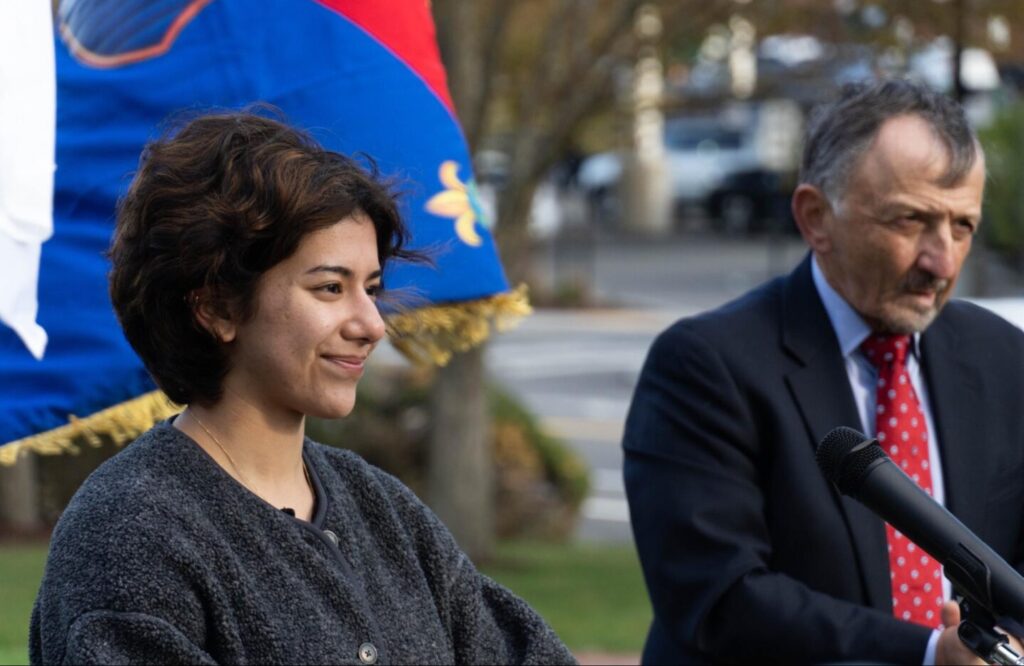
Bella Ishanyan’s father, Ara Ishanyan, helped lead the effort to organize the commemoration in Newton for the second consecutive year. He said this year’s event expanded on the first, in part because organizers began planning earlier.
“It gave us time to think through what we wanted the message to be,” Ara said.
Like many Armenian Americans, Ara said his grandparents on his mother’s side came from central Anatolia. On his father’s side, his grandparents later settled in Istanbul, where they lived for about 40 years and where his father was born.
“They were all genocide survivors,” he said.
Bella said that as a child, she learned about the stories of her medzmayr (grandmother) and medzbaba (grandfather).
“We’re always taught about their story and about how they came to the United States and how they sacrificed just to make it this far,” she said.
Bella, a 2024 graduate of Newton South High School, said one goal in Newton has been to expand understanding of Armenian history. She pointed to a recent change in the high school curriculum she contributed to, where the unit on the Armenian Genocide was extended from one day to two.
“Newton is such a diverse and inclusive place, but it’s just about making sure that people know where to spread that inclusivity,” she said. “The fact that so many people have turned out, it’s really such a beautiful thing, something that we couldn’t have imagined five years ago. The Armenian community is strong.”
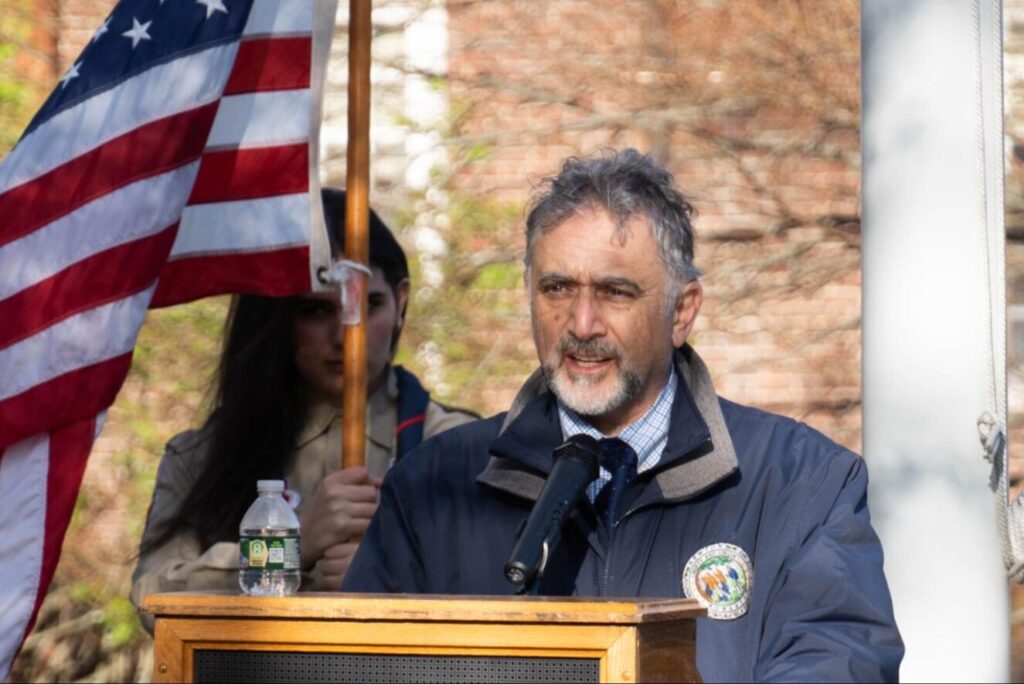
John Daghlian, an associate city engineer with Newton’s Department of Public Works and one of the event’s organizers, said his paternal grandfather, for whom he is named, married and had seven children. When he returned from military service, he found that his wife and children had been killed. He fled to a neighboring village.
On his mother’s side, Daghlian said his grandparents survived the genocide but later faced persecution under the Turkish government.
Daghlian said his parents immigrated to the United States in 1967, where they raised him and his siblings.
“We serve the community as best we can,” Daghlian said. “We hope that other nations learn to be careful, to treat people with respect, so these genocides don’t happen again but unfortunately they still do.”

Robert Avakian, grand commander of the Knights of Vartan, addressed the crowd.
“We have learned a lot after 111 years, but things haven’t changed that dramatically, have they?” Avakian said.
He said that many Armenians today struggle with a sense of purpose as their nation faces ongoing uncertainty, shaped in part by broader global unrest.
“We seem to be holding our collective diasporan breath in anticipation of dire news,” he said.
The Turkish government does not recognize the Armenian Genocide.
James Kaloustian provided the concluding remarks before the final benediction. He said he grew up attending services at Holy Trinity Armenian Church. To this day, one of his favorite features is a mural of Vardan Mamikonian, an Armenian military leader and saint, on the back wall of the sanctuary.
Kaloustian said his maternal grandfather witnessed his parents being killed by Turkish soldiers during the early massacres of the 20th century. His maternal grandmother arrived at Ellis Island with little more than clothing and a family Bible.
On his father’s side, he said his grandmother also survived the massacres, eventually fleeing to Europe before settling in Massachusetts, where she met his grandfather, a freedom fighter for the Armenian cause. Kaloustian said he got to know only one of his four grandparents.
“Their stories about the old country, our faith, and our heritage, as well as their dreams of a better life in America, are etched in my heart and soul as if they passed them to me themselves,” Kalousian said.
He recalled the 100th anniversary in 2015, when Armenians around the world came together in remembrance. He said he hopes that momentum –and the growing contributions of Armenian Americans – will continue in the years ahead.
Levon Belekian, a Needham resident and first-generation Armenian American, said many of his relatives were displaced from their homes abroad.
“My father made the leap and came over here,” Belekian said.
He said he hopes his children remain connected to their heritage and understand their family’s history.
“They often say, you know, Armenians are like roots of a tree,” he said. “You can throw us anywhere in the world, and we will grow.”