



In the early 1980s, the State requested, then required, that school districts assess basic skills using tests that the State provided and scored. The testing was driven by a nationwide fear that public schools were graduating poorly educated students unable to compete in the international economy. Newton’s Annual City Report regularly touted its students’ “significantly higher than school systems nationally” scores on SAT and other standardized tests and noted the “numerous awards and honors conferred on teachers and students.”[1]
The basic skills tests provided by the State were “aimed at identifying students needing remedial assistance” and required information about students’ race. Newton had “always felt that collection and publication of such subgroup data would have a negative effect on students and, therefore, would be counter productive.”[2] Before the State tests, Newton Public Schools (NPS) had sorted student results by grade and compared schools using IQ and family income, which did not sit well with all parents:
“We had discovered the great disparity in academic achievement between students north of the Mass. Turnpike and those schools south of the turnpike. Superintendent Fink told us that Horace Mann was doing very well — even [considering] our IQ level and socio-economic standing. We continue to be alarmed by what we perceive to be historically lower expectations for our children and see it as a self-fulfilling prophecy.”[3]
In 1981, Newton students first took State Basic Skills tests in reading, writing, and mathematics, and 91% passed. Of those who failed, 42% were not “receiving special help” (i.e., tutored or on an Individual Education Plan (IEP)) and a disproportionate number were Black.[4]
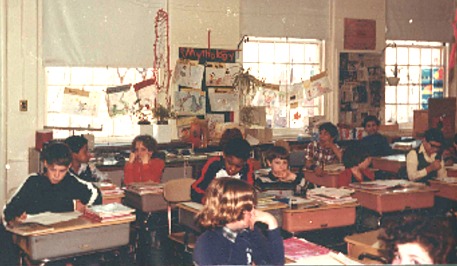
Horace Mann Elementary School (grades Kindergarten through sixth) had no students who had failed two of the three tests. The school used a phonics-based literacy program, Words in Color. Most schools used Ginn-basal readers (similar to Dick and Jane books). A May 8, 1978, School Committee report on Special Education discussed Horace Mann School’s “remarkably low incidence of learning disabilities” (LD). The school had no LD tutors and no students diagnosed with LD. Horace Mann fed into Day Junior High School. In 1978, Day had 59 students in an LD program; only one came from Horace Mann. There was no follow-up study of Horace Mann’s literacy program mentioned in the School Committee minutes. Both basal readers and phonics fell out of favor in the late 1980s as educators, such as NPS Language Arts Specialist Irene C. Fountas, began discussing whole-language instruction and promoting balanced literacy.
In 1981, NPS had 12,426 students[5], and 415 of those students were from METCO and comprised roughly two-thirds of the Black student population. Before the Basic Skills Test, the School Committee had assumed that the longer an underperforming student (Black or White) stayed in the school system, the more the student would improve academically. When asked about basic skills achievement, the METCO coordinator reported to the School Committee that “she and the METCO psychologist had the impression that over the years the older students are doing a lot better. …. For the most part, she said, she felt good about the progress METCO students were making.”[6] (Her reply matched the findings of an internal study done by the State, which assessed METCO students’ academic achievement over time, but did not compare it with students in their host community.[7]) At the time, the Newton School Committee’s main concern was a request from the Black Curriculum Coordinator to remove the film The Hunters from the curriculum.
Film: The Hunters
The Newton METCO staff, the Black Citizens of Newton, and others wanted teachers to stop showing The Hunters, a documentary of the African !Kung tribe produced by the Peabody Museum at Harvard University in 1957. The film was being used “with very little, if any, preliminary discussion”[8] by teachers across the grades.

“Black School Committee member Katherine Jones said use of the film is particularly inappropriate because of recent racial incidents in Boston and in Newton.
Last year in Newton, she said, an eight-year-old was subjected to taunts of [a racial slur]; a black student was told to “go back to Boston where you belong” by a substitute teacher; … students dressed as Ku Klux Klan members attempted to walk the corridors of Newton North; and, a black student with a perfect score on an exam was asked if he had seen the test before taking it.”[9]
In the mid-1960s, NPS had been involved in the development of a social studies curriculum, Man, a Course of Study, which had removed a unit on the !Kung as racially insensitive.[10] At the January 14, 1980 meeting of the School Committee, the Committee voted against curtailing teachers’ academic freedom and the banning of The Hunters film. Instead, they began a study on the “Development of Positive Racial Images in the Newton Schools.”[11]
Black families were not alone in questioning Newton’s curriculum. In 1983, a student asked why “Hitler’s heinous acts” and the Holocaust were not covered in their history of Europe textbooks.[12] Before the film controversy, the only hate crimes reported in School Committee minutes were in 1969 when Jewish students in Meadowbrook Junior High School (now Brown Middle School) were being attacked, robbed, and injured by “10 to 12 questionable boys.”[13] Charges were brought against some of the boys.

Racial tensions peaked in February of 1987, when a group of 4 to 40 (reports vary) “white students shouted racial slurs, threw snowballs and shattered two of the windows of a METCO bus leaving for Boston” at Newton North High School (North) following an off-campus robbery by Black students of “8 marijuana cigarettes” from a white former student.[14] The attack made national news. Racial harmony forums were held, students signed anti-racist pledges, and Mayor Theodore Mann formed a Blue Ribbon Commission on Race Relations in the Newton Schools. The final report of that commission dealt primarily with North, which had almost twice as many students as Newton South High School, and a smaller minority population (fewer Asian and Jewish students). North had 2,200 students, and 113 of them were Black.[15]
The Commission’s report found the racial climate among faculty at North had deteriorated in recent years due to budget pressure, which increased their class size and non-academic duties, as well as affirmative action, under which tenured staff with seniority could be laid off “for the purpose of maintaining affirmative action.”
The report stated that perceived unequal treatment between groups was a “deeply concerning issue.” The new Superintendent’s prioritization of Black students’ academic achievement embarrassed some Black students who felt it was reinforcing negative stereotypes, and it angered some White students by “its implied special treatment.”
The North school building itself was described as part of the problem:
“The building has many nooks and crannies, particularly around stairwells and exits, that provide natural protection for students pursuing illicit activities. Frequent locker break-ins have undermined students’ feelings of security and comfort at school. The difficulty in monitoring the behavior of the students out of their classrooms leads to a lack of responsibility on the part of students for keeping the premises clean. The result is constant littering. Some of the housemasters are distressed at the vandalism and untidiness and would like stronger disciplinary measures taken against such offenders.
It is generally agreed that the physical layout is not conducive to an atmosphere of well-being for the occupants.”
Changes were made. In 1987, North began offering a “holocaust curriculum” in 9th grade and holding an annual month-long celebration of Black history.[16] Newton police began tracking hate crimes in 1989, after a push from the Human Rights Commission following a series of anti-Semitic graffiti at schools,[17] including a swastika drawn on an Israeli Flag torn down from the ceiling of Newton North’s cafeteria.

North’s Global High School Committee had hung flags from students’ birth countries to celebrate the school’s diversity. The Irish and South African flags were also torn down. The Irish one went missing. The Global High School Committee had asked senior Liesl Tommy to carry the South African flag in a parade of banners. “I was kind of shocked when they asked me,” she told the Newton Graphic, “I lived under the system of apartheid – as a non-white — for half my life”. She wanted the South African flag removed and the banned African National Congress flag hung instead.[18] After two deadlocked meetings, the Student Faculty Administration Board, “North’s policy making council,”[19] decided to rehang the South African flag with a plaque that disavowed “the support of any government that suppresses the rights of its citizenry.”
Newton-Beijing Student Exchange Program
NPS had been building connections with schools and students outside of Massachusetts since the end of World War II. The first NPS student exchanges were with Wyandotte, Michigan, in 1948. A select group of about 30 students exchanged letters and studied the social, industrial, educational, and cultural aspects of the other community. In the spring, they visited each other’s school for a week. The exchanges expanded to other states and then to other countries in the 1960s. The high school American Field Service club raised funds to bring in visiting foreign students and sent one or two Newton students abroad each year.

There were also faculty exchanges “in conjunction with Harvard and the U.S. Agency for International Development.”[20] In 1963, NPS helped establish a high school in Lagos, Nigeria, and in 1964, NPS began faculty exchanges with Colegio Nueva Granada in Bogotá, Colombia. Some School Committee members felt these faculty exchanges were supporting private schools for the wealthy and found them “unbecoming.”[21]
In 1985, NPS began the first public school student exchange with China in the United States by hosting students and teachers from the Jingshan School in Beijing. The Chinese students attended high school classes and stayed with local families for four months. Two years later, four Newton High School students and two teachers spent three-and-a-half-months at the Jingshan School. The idea for the exchange began when Claire Kanter, a special education coordinator in NPS, met a Chinese English teacher while traveling in China. Chinese language classes were added at North and South High Schools to support the program.

During the spring of 1989, five Newton High School students and two of their teachers were in Beijing and witnessed the “massive public protests for democracy.” Some joined in marches with their Chinese classmates and offered water to protesters on hunger strikes.[22] The group came home a week and a half early because of the political unrest. They had been scheduled to return on June 3, the day the Tiananmen Square protests turned into a massacre. In the Lion’s Roar, South’s student newspaper, junior Zach Demko gave a first-hand account of the marches, hunger strikes, and over one million people peacefully protesting for democracy in the world’s largest public square.[23] Faculty and high school student exchanges, including the Newton-Beijing student exchange, continue to this day.
_______________
- Public Education, City of Newton, 1989 Annual Report [back]
- Vincent Silluzio, Assistant Superintendent, Newton School Committee Minutes, November 9, 1981, p. A-8 [back]
- Ann Hartner, parent, Public Comments, Newton School Committee Minutes, March 30, 1980, p. 1 [back]
- Vincent Silluzio, Assistant Superintendent, Newton School Committee Minutes, November 9, 1981, p. A-10 [back]
- City of Newton, Annual Report of Municipal Operations, Fiscal Year 1981 [back]
- Dr. Lyda Peters, METCO Report, Newton School Committee Minutes, May 12, 1980 [back]
- METCO Assessment 1975-1976, State Department of Education, Bureau of Research and Assessment, August 1976 [back]
- Newton School Committee Minutes, January 14, 1980, p. 1 [back]
- Newton Graphic, January 17, 1980, p. 1 [back]
- Susan Hegeman, Arctic Pedagogy: Indigenous People and the MACOS Culture War, Lateral, issue 10.2, 2021 [back]
- Report on the Development of Positive Racial Images in the Newton Schools, Newton School Committee Minutes, April 28, 1980, p. a [back]
- Newton School Committee Minutes, April 11, 1983, p. A-2 [back]
- Newton School Committee Minutes, June 23, 1969, p. 272 [back]
- The Lion’s Roar, Newton South student newspaper vol. 3, no. 4, p. 1 [back]
- Blue Ribbon Panel Report to Mayor Mann and the Newton Human Rights Commission, June 11, 1987, p.13 [back]
- Report on Blue Ribbon Commission on Race Relations in the Newton Schools, School Committee Minutes, October 13, 1987, A-9 [back]
- Newton TAB, November 14, 1989, 13 [back]
- Schools, Newton Graphic, January 4, 1989 [back]
- 1980 Newtonian, Newton North High School Yearbook, p. 78 [back]
- Richard Alpert, Professionalism, policy innovation, and conflict: School politics in Newton,Massachusetts, Harvard University Thesis, 1971, p. 513 [back]
- Report on Bogotá, Colombia, Newton School Committee, April 28, 1969 [back]
- Newton Graphic, May 31, 1989, p. 6 [back]
- Zach Demko, The peaceful demonstrations…and the bloody crackdown, The Lion’s Roar, June 7, 1989, p. 8-9 [back]
Next: Newton’s Plan to Raise Black Achievement and the Newton Academic Challenge Program