



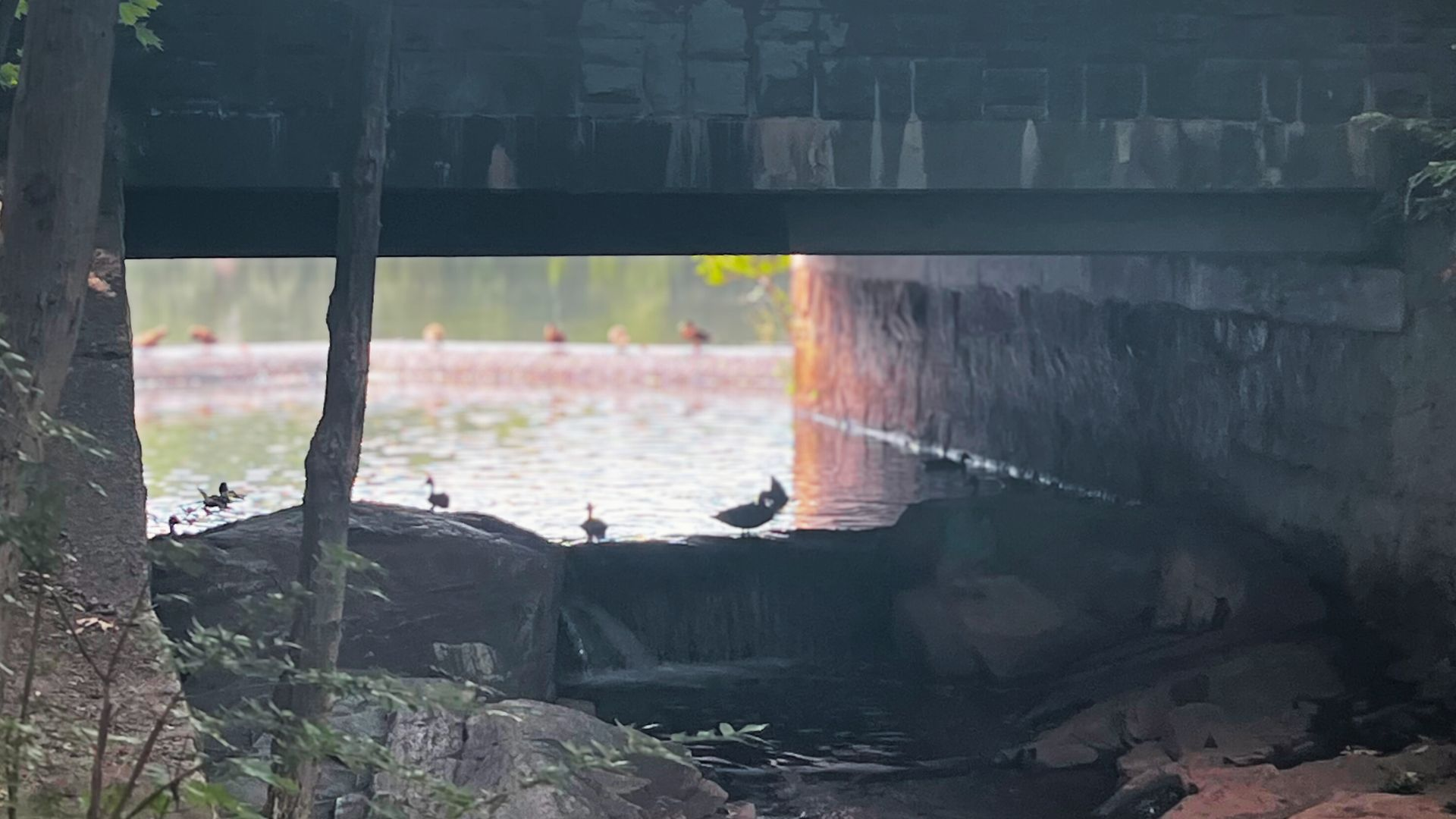
In recent weeks, the Laredo Administration has resumed discussions about repairs to Bullough’s Pond dam that, under former Mayor Ruthanne Fuller, sparked tensions and ultimately went unresolved. Laredo Administration officials are now presenting a variety of potential options for dam repair that could have a range of implications for the Newton community.
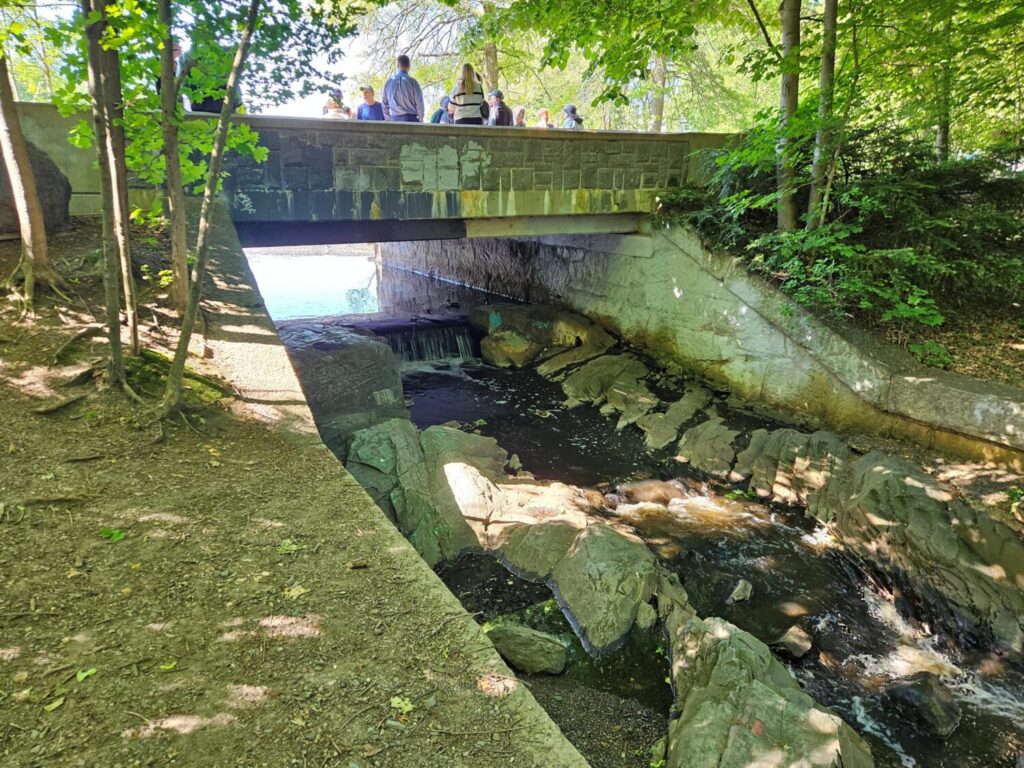
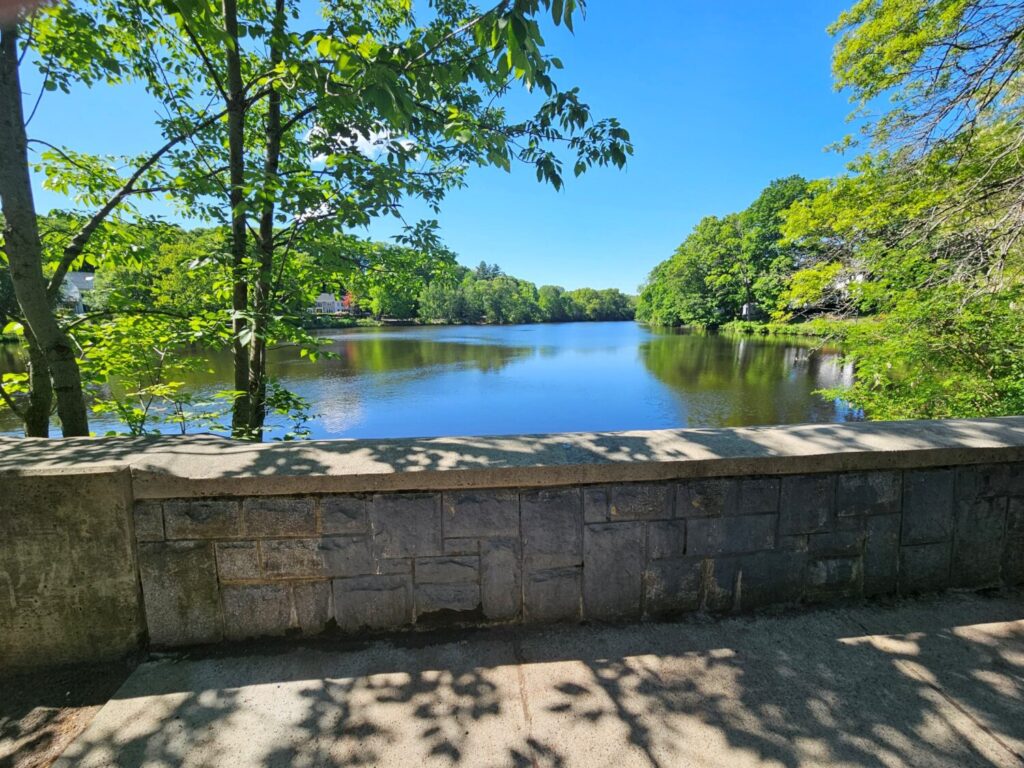
Bullough’s Pond, which is located across Walnut Street and Commonwealth Avenue from City Hall, features a historic dam originally built in 1664. In 1926, the dam was converted into a concrete-core wall dam. The dam’s spillway was modestly renovated in 1993, when Bullough’s Pond was last dredged. The dam has never been breached (broken) or overtopped (water flowing over the top).
A State-mandated project
In 2017 and 2018, the Massachusetts Office of Dam Safety (ODS) inspected the Bullough’s Pond dam and found it to be in “poor condition.” In 2018, ODS issued a Dam Safety Order to the City, requiring that Newton conduct a thorough inspection of and investigation into the dam.
The Fuller Administration hired an engineering firm, GZA Geo-Environmental, to carry out the studies. In 2020, GZA submitted its findings, which included several approaches that the City could take to repair the dam. All options involved the removal of trees and vegetation on the dam, which GZA said was consistent with ODS regulations.
In the months that followed, Newton residents and community members expressed significant concerns over GZA’s proposals, particularly with regard to removal of trees and vegetation. In response, the City sent a request to engineering firms soliciting other options for dam repair. An ideal proposal, the City said, would meet ODS requirements and minimize effects on the dam’s natural environment.
According to City Council records, the City received preliminary proposals from three firms: GZA, GEI Consultants, and Weston & Sampson. In 2021, the City moved forward with GEI.
Since then, GEI has continued to work with the City to finalize a plan. City Council records show that GEI employees have formally met with City Councilors at least four times since the firm was selected: at one Public Facilities Committee meeting in 2024, two Public Facilities Committee meetings in 2025, and one full City Council meeting in 2025.
In August 2025, then-Mayor Fuller announced that ODS had issued a formal request for an update and a “timeline for bringing the dam into compliance.” She urged the City Council to approve a controversial “downstream erosion protection” plan that her administration strongly recommended. But pushback and frustration continued. Then-City Council President Marc Laredo told Fig City News at the time that before a vote for approval could take place, the issue needed more discussion and a vote in the Public Facilities Committee.
The City Council has yet to approve a final plan.
In recent weeks, the Laredo Administration has engaged in a variety of conversations regarding the dam project. On May 28, the City’s Chief Operating Officer, Josh Morse, hosted a virtual community meeting, which the Laredo Administration framed as an “open dialogue” with residents and community members. On May 29, Morse hosted an on-site visit to the dam for interested community members. On June 17, Morse met with the Public Facilities Committee to discuss the project further.
In those meetings, Morse shared updated project plans and proposals, as well as the thought process behind the Laredo Administration’s approach.

Four options
Morse said that the City is currently considering four different options for dam repair, all of which were drawn up in collaboration with GEI. He made clear that they all involved tree loss to a certain degree, and he noted that the City will do its best to protect the dam’s natural environment, but the question of tree removal is ultimately up to ODS.
The first option, downstream erosion protection, is similar to the approach that the Fuller Administration recommended. This plan, Morse said, would strengthen the downstream side of the existing dam, preventing erosion in the event of water overtopping. Morse noted that this option has a lower upfront cost — but because it has a lower life expectancy than other options, it carries higher long-term maintenance costs. Morse also said that implementation would result in a significant loss of trees, a higher long-term risk of dam breach, and higher long-term risks of flooding. He likened this option to an airbag system in a car: “Airbags help limit injuries in a car accident. Downstream erosion protection systems help limit downstream erosion and reduce the likelihood of a dam breach,” he said.
“Even better than an airbag is to avoid the car accident altogether,” Morse added. Replacing the dam — options two and three — would be the equivalent of avoiding the car accident and therefore not needing the airbag.
Morse said that the second option would be to replace the current dam with a new concrete core-wall dam, essentially removing the existing core wall and putting a new one in its place. He said that this plan has a higher upfront cost, but because of its longer lifespan, it carries only “minimal” life-cycle costs. Morse also said that implementation would result in a modest loss of trees, a lower long-term risk of dam breach, and low long-term risks of flooding. “Solid option, pretty expensive,” he said.
Morse said that the third option would be to replace the current dam with a new buried secant pile wall dam. “It basically has interlocking teeth, for lack of a better word, that create a very strong structural system.” This plan, he said, has a modest upfront cost and “minimal” life-cycle costs thanks to its longer lifespan. Morse also said that implementation would result in a modest loss of trees, a very low long-term risk of dam breach, and very low long-term risks of flooding. “Less expensive, more bulletproof in the long term,” he said.
The fourth option, Morse said, would be to remove the Bullough’s Pond dam entirely, effectively turning the pond into a natural meadow or rain garden. He said that this plan has the highest upfront cost and the highest life-cycle cost. Morse also said that implementation would result in a modest loss of trees, and higher flood risks — both now and in the future.

Removing the dam, Morse said, essentially replaces one capital liability with another: it would eliminate the long-term cost of dam replacement, but it would require a much larger bridge to be constructed on the abutting Dexter Road — a project that he said would likely require property takings by eminent domain.
Morse also noted that removing the dam would have other significant ripple effects. Without Bullough’s Pond to store stormwater, the neighborhood would see increased downstream flooding during storms. In order to reduce that flood risk, the entire downstream Laundry Brook culvert system would need to be replaced and expanded. Expanding the culvert system, Morse said, would require hundreds of eminent domain property takings, hundreds of millions of dollars, and decades of work — plus coordination with Watertown leadership, as a section of the culvert runs through their city.
“Based on the restrictions of the Laundry Brook culvert, even if dam removal was free, I would not recommend it,” Morse said. “It’s a unique situation. I would feel very differently under different circumstances if we had the capacity downstream.”
In City Council meetings under the Fuller Administration, GEI representatives said that dam removal was not being considered as a viable option.
In a statement to Fig City News, Morse explained that the Laredo Administration took a closer look at dam removal in response to requests from stakeholders.
“Dam removal was not previously considered by the prior administration as it was not something that was deemed viable,” he said. “However, a few members of the community and City Council asked that we complete the analysis to prove out the previously held position that dam removal was not a viable solution given the specifics of this project, the surrounding area, and the stormwater infrastructure throughout Newton.”
Opinions and recommendations
Across all the recent meetings, various community members, City Councilors, and other stakeholders shared different perspectives. Many attendees took the opportunity to ask Morse technical questions about the dam-repair options he presented. Others voiced their own opinions on the proposals.
Some attendees were particularly opposed to the dam removal option. Michael Swain, who identified himself as a Newton resident who lives near Bullough’s Pond, said during the virtual community meeting that he wanted to make clear “what a loss it would be to remove the dam and not have a pond there.” Christine Rankovic, a Newton resident who spoke at the on-site dam site visit, offered a similar point of view: “The natural beauty, why throw that away?” she said. “The idea that [dam repairs] could actually lead to getting rid of the pond is obscene.”
Not everyone felt the same way. Amber Siegel, a representative from the Charles River Watershed Association, said that her organization is “a proponent of dam removal when and where it makes sense,” and noted that community members would still be able to enjoy the Bullough’s Pond area even if the dam were removed. “I do think it would be very different, but a wetland setup can still be a beautiful recreation space,” she said.
Alan Nogee, who attended the dam site visit, shared a similar perspective. “If the dam were removed, [Bullough’s Pond] could become a gorgeous park,” he said. “I totally appreciate the value of [a water view], but it could become a very beautiful park with more biodiversity and wildlife support than the pond provides.”
On June 5, the Bullough’s Pond Dam Working Group — a body that includes four City Councilors, the Commissioner of Public Works, the City Engineer, Bullough’s Pond Association members, Morse, and others — took a straw vote in favor of the buried secant pile wall dam option.
The Working Group’s draft recommendation shows that members used a “criteria matrix” to evaluate the four options, assigning each a score of “favorable” (+1), “neutral” (+0), or “unfavorable” (-1). At the on-site visit to the dam hosted by Morse, he said he is a strong proponent of this “criteria matrix” approach to evaluating alternatives.
“Based on the criteria matrix, the buried secant pile wall alternative received the highest overall score and combines the lowest estimated construction costs with the strongest long-term risk profile,” Morse told the Public Facilities Committee in the June 17 meeting. “This option was overwhelmingly supported by the Working Group, the consultant, the City Engineer and the Commissioner of Public Works.”
“This option has also been supported by the overwhelming majority of residents who have expressed their opinion on the Bullough’s Pond dam project to date,” he added.
Looking back, and turning to the future
In the June 17 Public Facilities Committee meeting, City Councilor Andrea Kelley (Ward 3) reflected on her experience with the dam project. She said that it felt like things were moving in the right direction, but that she felt frustrated that it had taken so long to get to the latest options.
“It does seem frustrating to me, having sat through seven to nine years of this, that now there’s a whole new idea. That happens, but why has this not come up before?” she said.
Morse emphasized that if he had been involved with the project since the beginning, he would have made some different choices. (Morse assumed the role of Chief Operating Officer in January 2026.)
“I would love to have been here seven years ago on this working group,” he said. “Sometimes, I think there is a tendency to look at the most inexpensive, easiest pathway towards compliance when you’re in a situation like this. I think that it can sometimes be challenging to make a decision that requires a higher upfront investment, but ultimately a better overall product and a lower life-cycle cost. I think it’s as simple as that.”
City Councilor Rena Getz (Ward 5) said that she was pleased with the recent progress on the project.
“I sort of feel for the first time on this topic, I really feel that we did the scope, we got really solid information, and I am just elated that we’re at a place where we can make really solid decisions,” she said.
Once Mayor Laredo makes a dam-repair recommendation to the City Council — and the City Council votes to approve it — the project can begin to move forward.
In a June 15 statement to Fig City News, Morse said that he anticipates that Mayor Laredo will make a final recommendation in the coming weeks.
“Once [the Mayor’s] decision is made, and pending an indication that the City Council supports the approach, the project will move into the next phase of design,” he said. “Design will take about a year to complete, and then we will bid the project out and begin construction.”
Theo Younkin is a 2026 graduate of Newton South High School, former co-Editor-in-Chief of the NSHS Lion’s Roar, and a Fig City News student intern.